

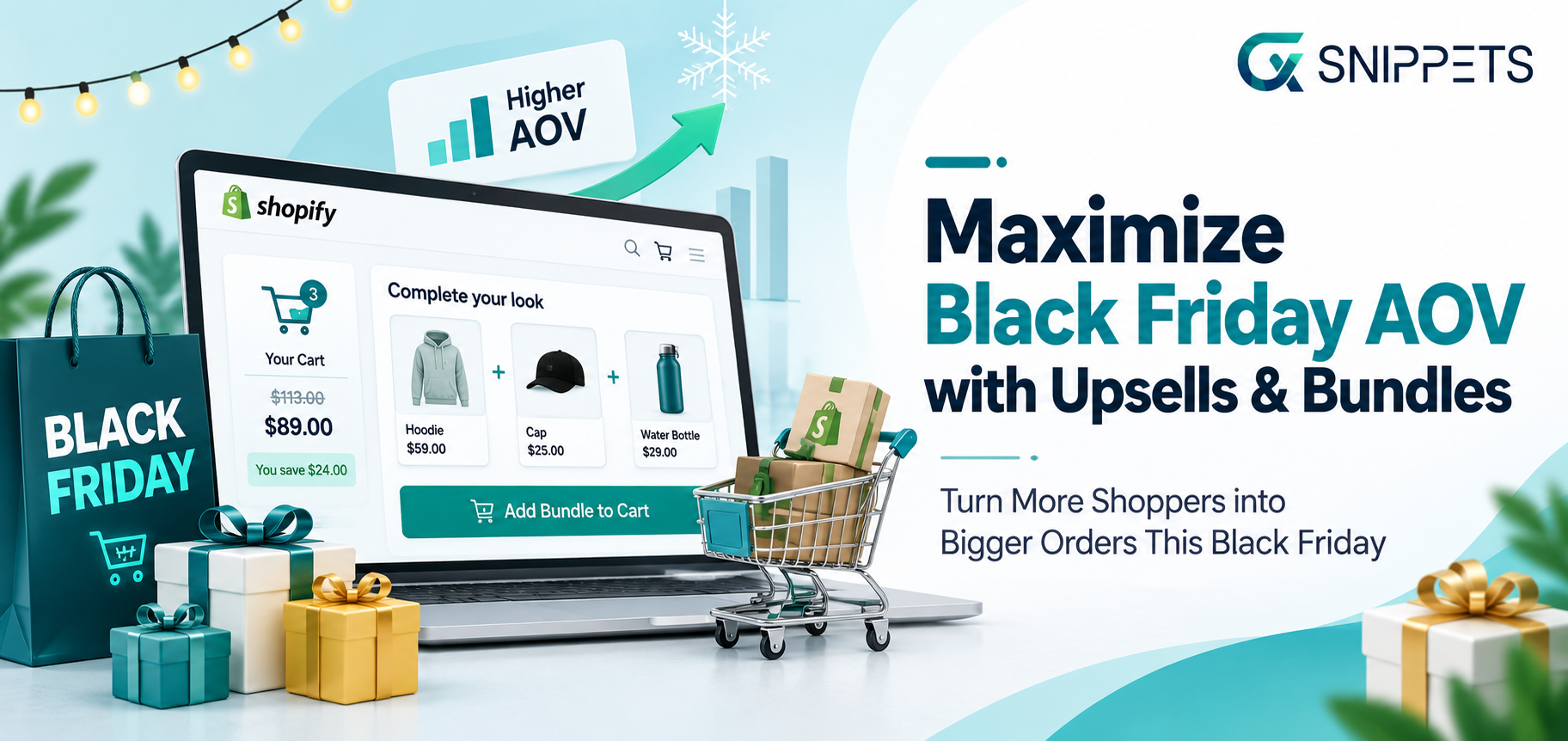
The fastest way to increase average order value during Black Friday Cyber Monday (BFCM) is to encourage shoppers to spend more in a single purchase through strategic upsells and product bundles.
Instead of investing more in ads to acquire additional customers, Shopify merchants can generate more revenue from existing traffic by offering relevant product upgrades, complementary products, and value-packed bundles at key points in the buying journey.
If you’re wondering how to increase average order value, the answer isn’t simply offering deeper discounts.
In A Hurry? Here’s A Brief Summary…
- AOV equals Total Revenue divided by Total Orders. A store earning $25,000 from 500 BFCM orders has a $50 AOV, and raising that number increases revenue without spending more on ads.
- Upsells and bundles are the fastest way to raise AOV during BFCM, because they monetize existing traffic instead of requiring you to acquire new customers.
- Upsells increase the value of one product, such as a $20 water bottle upgraded to a $35 insulated version, while bundles increase the number of products per order, such as shampoo, conditioner, and hair mask sold together as a $49 bundle.
- The highest-performing Shopify stores combine both strategies rather than choosing one, offering a bundle first, then an upsell before checkout.
- Placement should match buying intent. Bundles and upgrades work best on product pages, complementary add-ons work best on the cart page, simple single offers work best at checkout, and accessories or refills work best as post-purchase offers.
- Four metrics matter for measuring success, AOV, upsell conversion rate, bundle attach rate, and revenue per visitor, not AOV alone, since an upsell that raises AOV but tanks conversion isn’t a net win.
- The most common mistake is over-offering. Showing too many upsells, irrelevant recommendations, or stacked discounts increases friction and can lower conversion during BFCM’s already crowded shopping period.
Successful Shopify brands focus on increasing cart value by presenting the right offer at the right time.
During BFCM, shoppers are already in a buying mindset, making it the perfect opportunity to use a well-planned Shopify bundle, checkout upsell, or post-purchase offer to drive higher revenue per order.
For many merchants, improving Shopify average order value can have a greater impact on profitability than increasing website traffic. Even a modest increase in average order value Shopify metrics can significantly boost Black Friday revenue without raising advertising costs.
Table Of Contents
- What Is AOV and Why Does It Matter During BFCM?
- Upsells vs Bundles: What’s the Difference?
- 5 Proven Upsell Strategies for BFCM
- 5 Product Bundle Ideas That Increase BFCM Revenue
- Where to Place Upsells and Bundles for Maximum Impact
- Common Mistakes That Hurt BFCM Sales
- How to Measure Success and Maximize BFCM AOV
- Frequently Asked Questions (FAQ’s)
What Is AOV and Why Does It Matter During BFCM?
Average Order Value (AOV) is the average amount a customer spends per transaction in your store.
It’s one of the most important eCommerce metrics because it shows how much revenue you’re generating from each order.
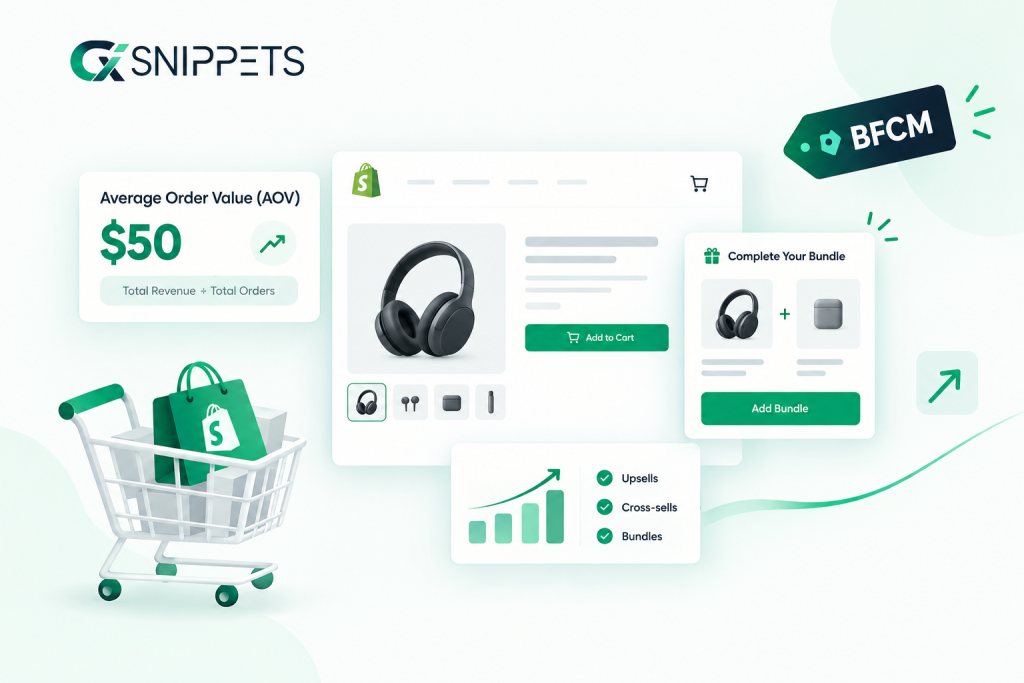
The higher your AOV, the more revenue you can earn without increasing traffic or acquiring more customers.
Shopify AOV calculation formula is straightforward:
| Metric | Formula |
|---|---|
| Average Order Value (AOV) | Total Revenue ÷ Total Number of Orders |
For example, if your Shopify store generates $25,000 from 500 orders during a Black Friday campaign:
AOV = $25,000 ÷ 500 = $50
This means the average customer spends $50 per order.
If you’re looking for the Shopify AOV average order value calculation, simply divide your total sales revenue by the total number of orders within a specific period.
Most Shopify merchants track this metric before, during, and after BFCM to measure the effectiveness of their upsells, cross-sells, and bundle offers.
Why AOV Matters More During BFCM
Many merchants focus entirely on driving more traffic during Black Friday Cyber Monday. While traffic is important, it also becomes significantly more expensive as competition increases. That’s why one of the smartest ways to increase average order value is to maximize revenue from the shoppers already visiting your store.
| Scenario | Orders | AOV | Revenue |
|---|---|---|---|
| Store A | 1,000 | $50 | $50,000 |
| Store B | 1,000 | $65 | $65,000 |
With the same number of orders, Store B generates $15,000 more revenue simply because it has a higher AOV.
This is exactly why learning how to increase average order value should be a priority before launching your BFCM campaigns.
A well-placed upsell, product recommendation, or Shopify bundle can increase cart value without requiring additional ad spend.
Why Upsells and Bundles Are So Effective During BFCM
BFCM shoppers are different from regular shoppers. They often arrive with a stronger intent to buy, larger budgets, and a desire to maximize savings. This creates the perfect opportunity to present relevant upgrades and Shopify bundles that offer additional value.
For example:
- A customer purchasing a skincare product may be interested in a complete skincare bundle.
- Someone buying a gaming keyboard may also purchase a matching mouse as part of a bundle offer.
- A shopper spending $45 may add another item to qualify for free shipping.
These small additions can dramatically increase average order value across hundreds or thousands of orders.
Upsells vs Bundles: What’s the Difference?
Upsells and bundles are two of the most effective ways to increase average order value, but they work differently.
An upsell encourages customers to purchase a higher-value version of a product or add a premium upgrade, while a bundle combines multiple products into a single offer to increase the overall cart value.
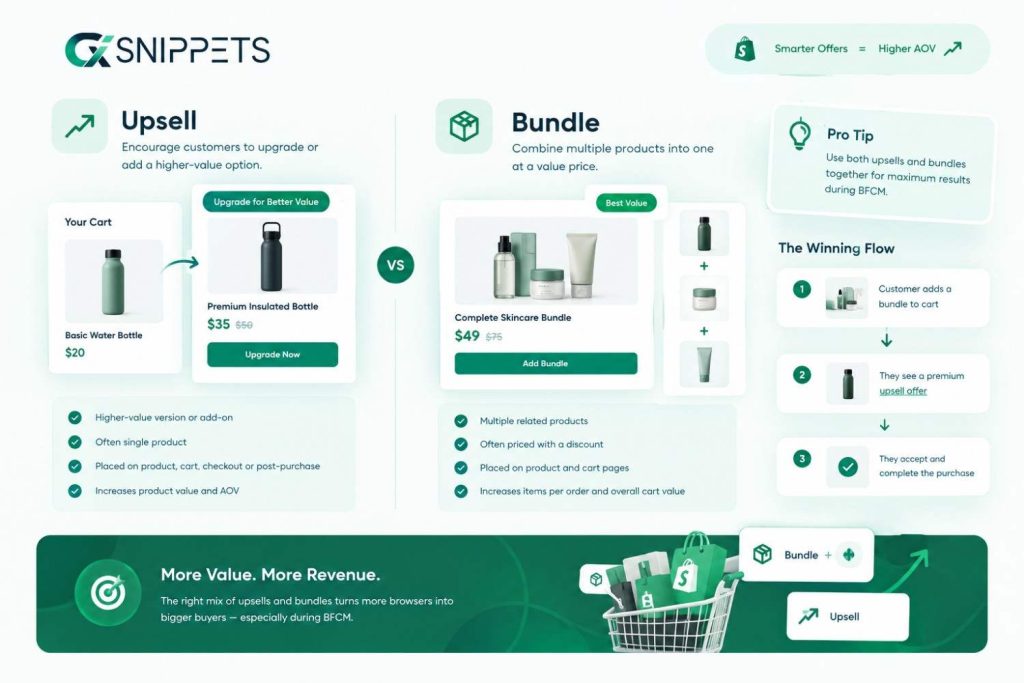
The best-performing Shopify stores don’t choose one strategy over the other.
Instead, they use upsells and Shopify bundles together to maximize revenue throughout the customer journey.
What Is an Upsell?
An upsell encourages shoppers to spend more by upgrading their purchase or adding a higher-value option.
For example:
| Customer’s Choice | Upsell Offer |
|---|---|
| Basic Water Bottle ($20) | Premium Insulated Bottle ($35) |
| Standard Headphones ($50) | Noise-Canceling Headphones ($85) |
| Basic Skincare Product ($25) | Complete Premium Version ($40) |
What Is a Product Bundle?
A product bundle combines related products into a single package, often at a slightly discounted price compared to purchasing items separately.
For example:
| Individual Products | Bundle Offer |
|---|---|
| Shampoo ($20) + Conditioner ($20) + Hair Mask ($15) | Hair Care Bundle ($49) |
| Keyboard ($70) + Mouse ($30) | Gaming Bundle ($90) |
| T-Shirt ($25) + Shorts ($25) | Summer Outfit Bundle ($45) |
A well-designed Shopify bundle makes purchasing easier while encouraging customers to buy more products in a single order.
Many merchants use Shopify bundles during BFCM because shoppers are actively looking for the best value and complete solutions rather than individual products.
Upsells vs Bundles: Quick Comparison
| Factor | Upsells | Bundles |
|---|---|---|
| Primary Goal | Upgrade a purchase | Increase cart size |
| Products Involved | Usually one product upgrade | Multiple related products |
| Best Placement | Product, cart, checkout, post-purchase | Product and cart pages |
| Customer Benefit | Better version of a product | Better overall value |
| Impact on AOV | Higher product value | More items per order |
Which Strategy Is Better for BFCM?
The answer is neither. The highest-performing stores use both.
A customer might first purchase a Shopify bundle containing complementary products and then accept an upsell for a premium version, extended warranty, gift wrapping, or additional accessories.
For example:
- Customer adds a “Winter Skincare Bundle” to their cart.
- They are shown a premium serum upsell.
- They accept the offer before checkout.
Instead of increasing revenue from one tactic, the store benefits from both bundling Shopify products and strategic upselling.
5 Proven Upsell Strategies for BFCM
If your goal is to increase average order value during BFCM, don’t treat every shopper the same. The most effective upsells are relevant to what the customer is already buying and appear at a moment when adding another product feels natural.
Here are five practical upsell strategies Shopify merchants can use during Black Friday Cyber Monday.
1. Offer a Premium Upgrade
Give shoppers an easy way to move from a standard product to a higher-value version.
For example, if a customer adds a $40 coffee maker to their cart, offer a premium $60 model with better features for an additional $20. The customer gets more value, while the merchant increases the average order value Shopify stores generate from the same purchase.
BFCM tip: Make the price difference easy to understand. During a sale, shoppers are already comparing deals, so clearly showing the additional value can make an upgrade more appealing.
2. Recommend Relevant Add-Ons
Don’t wait until customers reach checkout to suggest complementary products. Recommend items that naturally complete their purchase.
For example:
- Running shoes → running socks
- Camera → memory card
- Laptop → laptop sleeve
- Skincare → moisturizer
- Coffee machine → coffee beans
The key is relevance. A random recommendation can feel like an interruption, while a useful add-on feels like helpful shopping guidance.
3. Use a Free-Shipping Threshold Upsell
A free-shipping threshold can turn an extra purchase into a clear goal.
For example:
You’re $15 away from free shipping. Add one more item to unlock it.
This works particularly well during BFCM because shoppers are already looking for ways to get more value from their orders.
Instead of simply saying “Buy more,” show customers what they need to spend and what they get in return. This can be an effective way to increase average order value without giving every customer another percentage-based discount.
4. Add Cart and Checkout Upsells
The cart and checkout are high-intent moments because customers have already decided to buy. This makes them useful places to present a final, highly relevant offer.
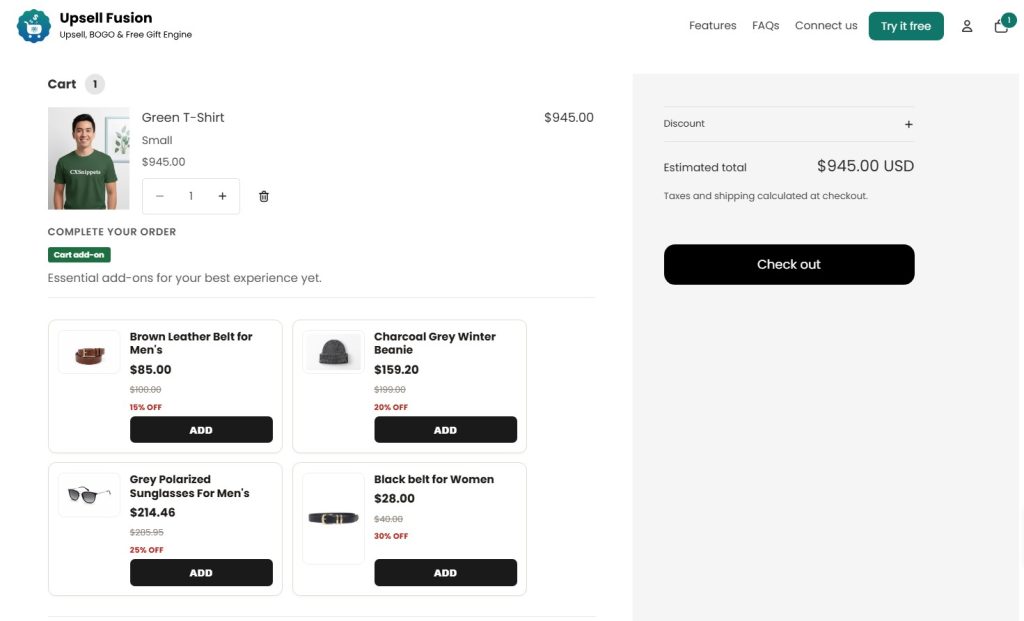
For example, after a customer adds a $100 fitness product, you could offer:
Add resistance bands for $15 instead of $25.
Keep these offers simple. BFCM shoppers often move quickly between deals, so presenting multiple competing offers can create friction instead of increasing AOV.
5. Use Post-Purchase Upsells
The sale doesn’t necessarily end when the customer clicks Buy.
A post-purchase upsell gives shoppers another relevant offer after completing their original order.
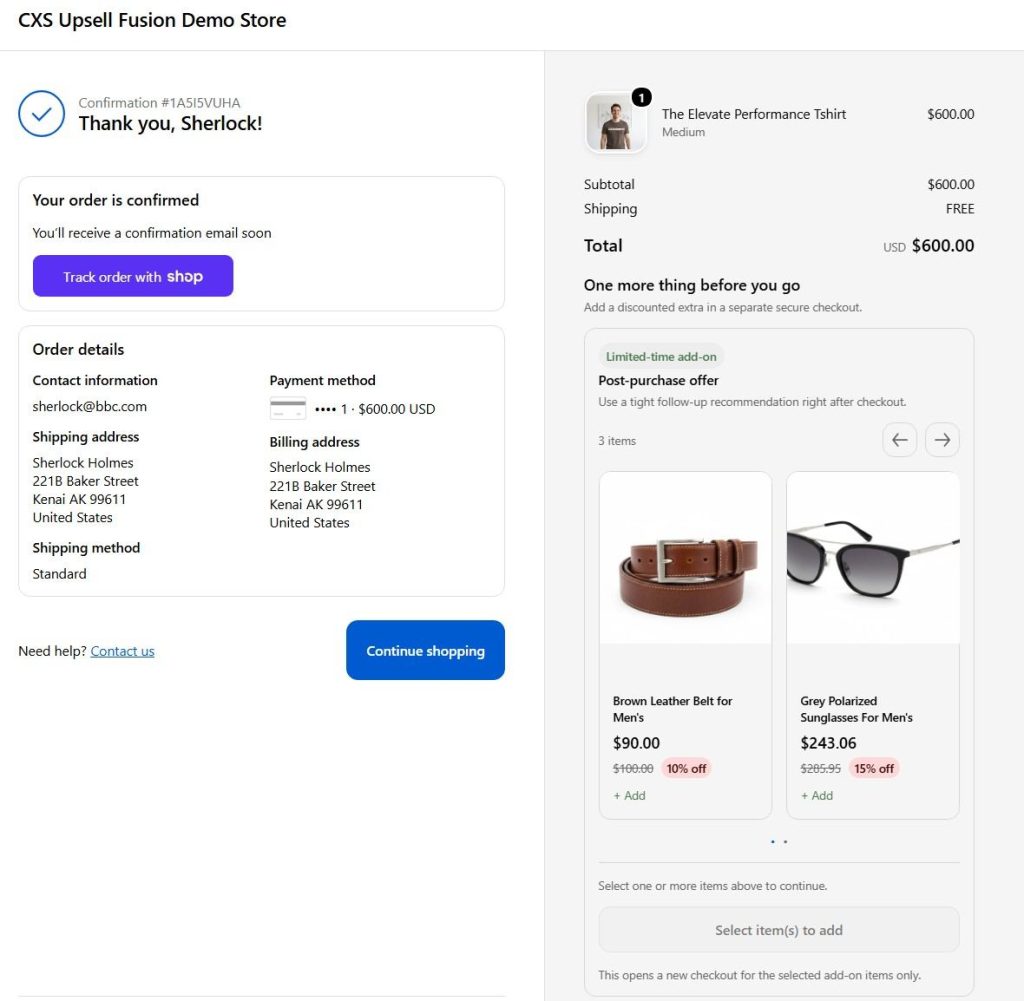
Because the initial purchase is already complete, customers can consider an additional product without repeating the entire checkout process.
For example:
Your order is confirmed. Add a matching accessory for 20% off.
Post-purchase offers work particularly well for complementary products, accessories, refills, and low-friction add-ons.
Make Every Upsell Relevant
The biggest mistake merchants make is assuming that more offers automatically mean a higher Shopify average order value. They don’t.
A better BFCM approach is to ask:
“What would genuinely make this customer’s purchase more useful?”
If the answer is obvious, that product is a strong upsell candidate. If the recommendation requires a long explanation, it probably isn’t the right offer for that moment.
Tools such as CXS Upsell Fusion can help Shopify merchants automate these offers and create different upsell campaigns based on products, cart contents, and customer behavior.
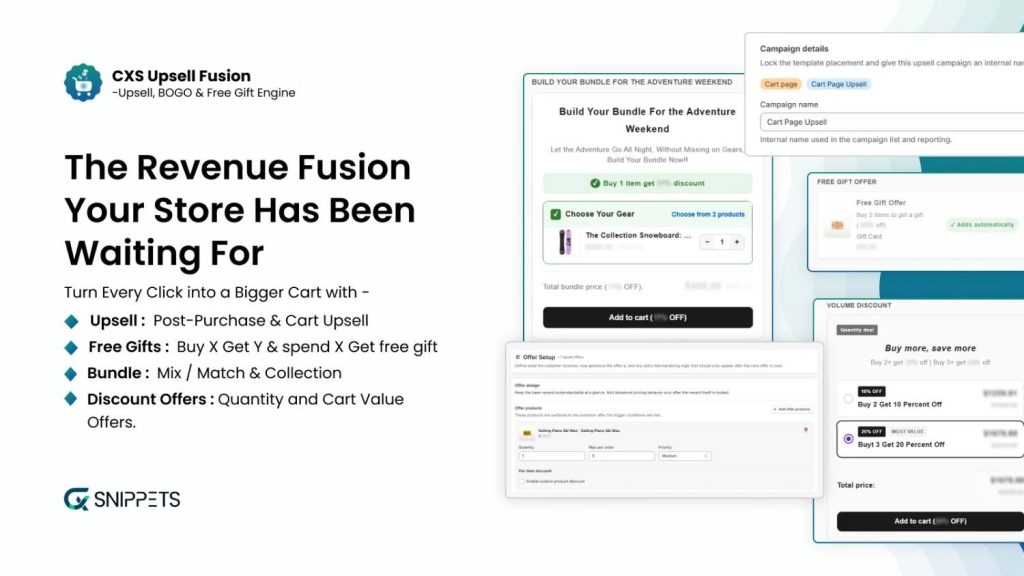
This allows merchants to focus on their BFCM strategy instead of manually managing every offer.
The goal isn’t to push customers into buying something they don’t need. It’s to make the next relevant purchase easier, increasing order value while improving the overall shopping experience.
Turn BFCM Upsells Into Automated Offers
5 Product Bundle Ideas That Increase BFCM Revenue
Product bundles can be one of the simplest ways to increase average order value during BFCM. Instead of convincing a shopper to buy an unrelated product, you package products that naturally belong together and give them a reason to purchase more in one order.
The key is to build bundles around customer needs, shopping occasions, or complementary products, rather than simply putting slow-moving products together.
Here are five Shopify bundle ideas worth testing during BFCM.
1. Frequently Bought Together Bundles
Combine products customers already tend to purchase together.
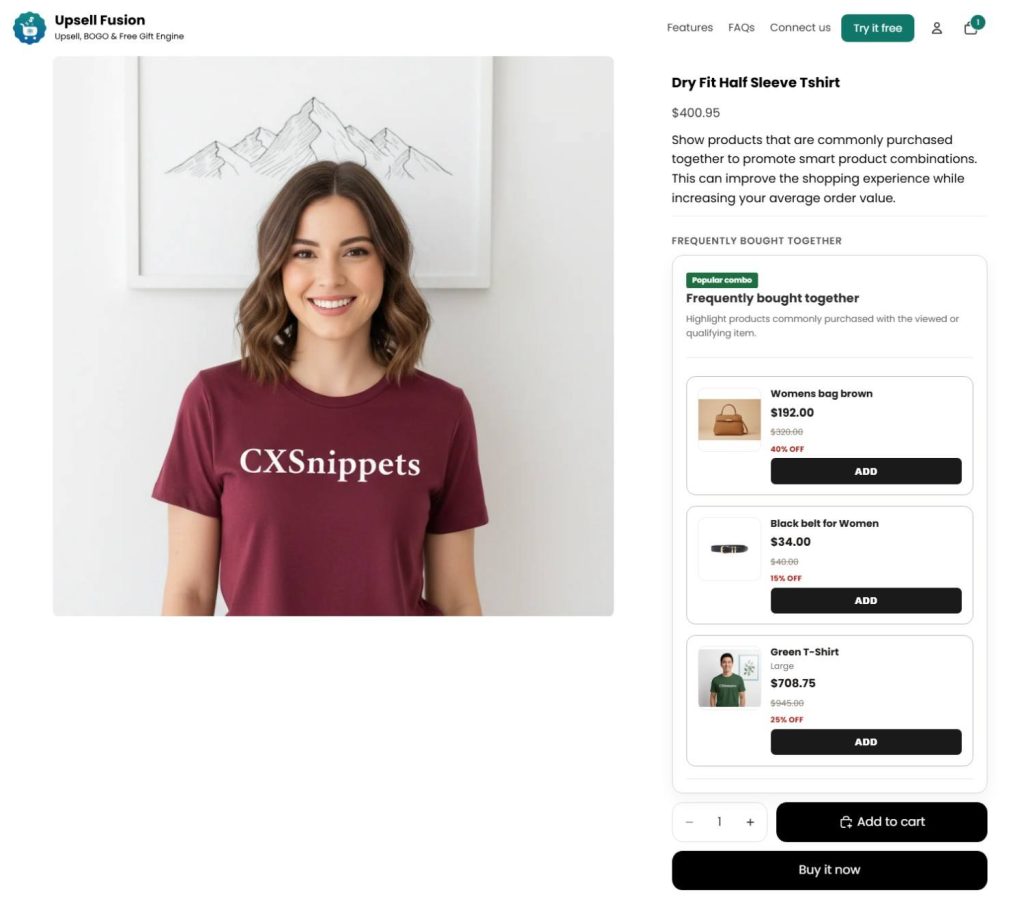
For example:
- Phone case + screen protector
- Camera + memory card
- Shampoo + conditioner
- Coffee machine + coffee beans
This is one of the safest approaches to bundling Shopify products because you’re building the offer around existing purchasing behavior.
BFCM tip: Give the bundle a small incentive, but don’t make the discount so large that it eliminates your margin.
2. Gift-Ready Bundles and Free Gifts
BFCM isn’t only about personal shopping. Many customers are buying gifts for family, friends, and colleagues.
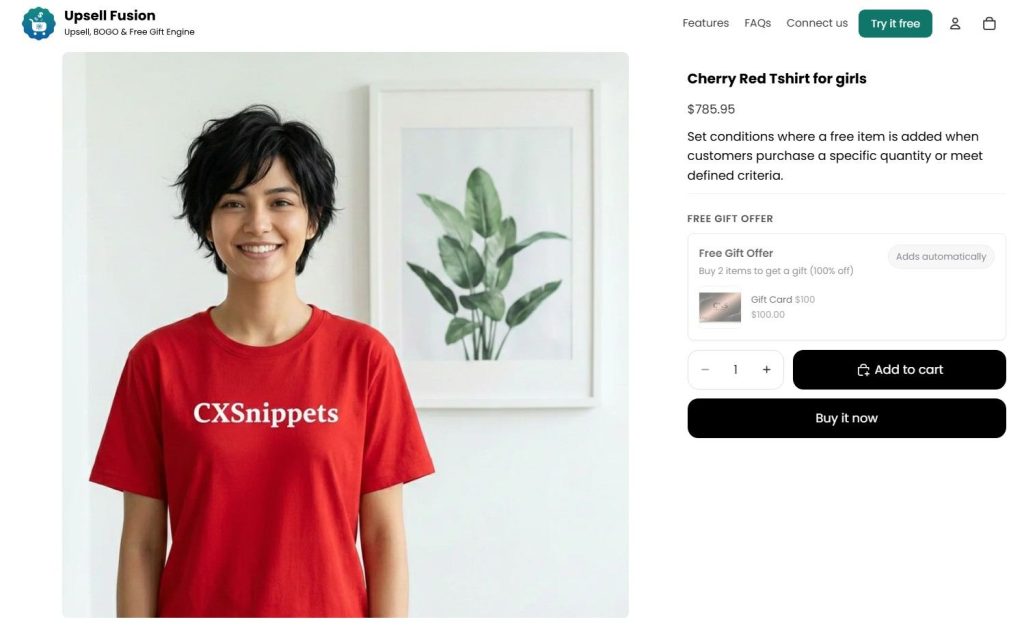
Create ready-to-buy bundles around occasions such as:
- “Gifts for Her”
- “Holiday Self-Care Kit”
- “Gamer Gift Set”
- “Stocking Stuffer Bundle”
A gift-ready Shopify bundle removes the effort of finding individual products, which can be particularly valuable when shoppers are buying multiple gifts at once. You can also add a free gift card offer to encourage users to buy that exact product.
3. Starter Kits
Help first-time customers get everything they need to start using a product.
For example, a skincare store could offer:
Cleanser + Serum + Moisturizer = Complete Skincare Starter Kit
Instead of asking shoppers to figure out which products work together, the bundle gives them a complete solution.
This approach can also help increase average order value because customers who might have purchased one product are presented with a complete set.
4. Buy More, Save More Bundles
Give customers a reason to increase their quantity.
For example:
- Buy 1 → $20
- Buy 2 → $36
- Buy 3 → $48
This strategy works particularly well for consumable or repeat-purchase products such as supplements, coffee, cosmetics, stationery, and household products.
5. BFCM-Exclusive Seasonal Bundles
Create a bundle specifically for the Black Friday shopping period rather than simply applying a sitewide discount.
For example:
BFCM Weekend Bundle: 3 Best-Selling Products for $79
This creates a clear reason to purchase now while giving merchants an opportunity to combine best sellers, complementary products, or selected inventory.
It can also create urgency without relying entirely on aggressive discounts.
How to Choose the Right Products for a Bundle
Before creating multiple Shopify bundles, look at your existing sales data. Identify products that:
- Are frequently purchased together
- Complement your best sellers
- Have healthy profit margins
- Solve a specific customer need
- Can be explained in one simple offer
Avoid creating a bundle Shopify offer just because two products need to be cleared from inventory. If the products don’t make sense together, customers are unlikely to see the value.
The strongest BFCM bundles should make customers think:
“I was going to buy this anyway, and getting these products together makes the purchase easier or more valuable.”
That is what turns bundling Shopify products from a simple discount tactic into a strategy for increasing cart value.
Where to Place Upsells and Bundles for Maximum Impact
The best place for an upsell or bundle is where the customer is already showing buying intent.
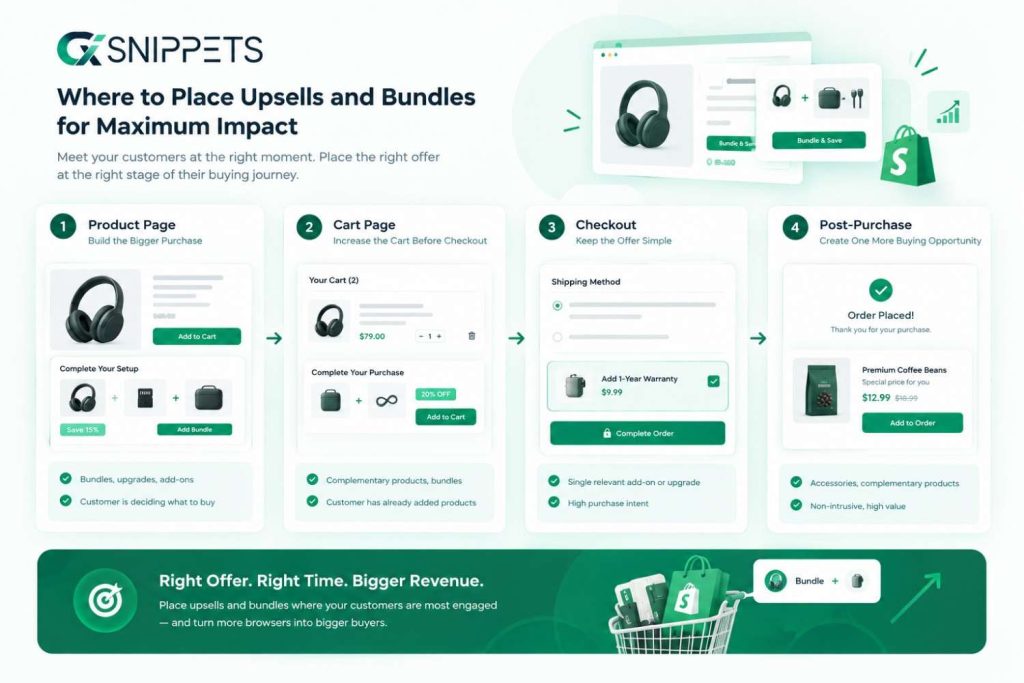
Instead of displaying the same offer everywhere, Shopify merchants should match the offer to the customer’s stage in the buying journey.
| Store Placement | Best Offer | Why It Works |
|---|---|---|
| Product Page | Bundles, upgrades, add-ons | Customer is deciding what to buy |
| Cart Page | Complementary products, bundles | Customer has already added products |
| Checkout | Small add-ons, upgrades | Purchase intent is very high |
| Post-Purchase | Accessories, complementary products | Original purchase is already complete |
Product Page: Build the Bigger Purchase
The product page is ideal for introducing Shopify bundles, product upgrades, and relevant add-ons before the customer commits to their purchase.
For example, someone viewing a camera could see a bundle containing a memory card and camera bag. The customer gets a complete setup, while the merchant gets a larger order.
Cart Page: Increase the Cart Before Checkout
The cart is one of the strongest opportunities to increase average order value because customers have already selected at least one product.
Use this space for offers such as:
- “Complete your purchase with…”
- “Add this for 20% off”
- “You’re $15 away from free shipping”
- “Frequently bought together”
Keep the recommendation closely related to what’s already in the cart.
Checkout: Keep the Offer Simple
At checkout, avoid presenting customers with complicated bundles or several competing recommendations. A single relevant add-on or upgrade is usually easier to act on.
For BFCM, this could be a low-priced accessory, warranty, refill, or other product that complements the main purchase.
Post-Purchase: Create One More Buying Opportunity
Once an order is n completed, a relevant post-purchase upsell can increase the value of the transaction without interrupting the original checkout.
For example, a customer who purchased a coffee machine could be offered a discounted pack of coffee beans immediately after checkout.
Common Mistakes That Hurt BFCM Sales
Upsells and Shopify bundles can help merchants increase average order value, but poorly planned offers can have the opposite effect.
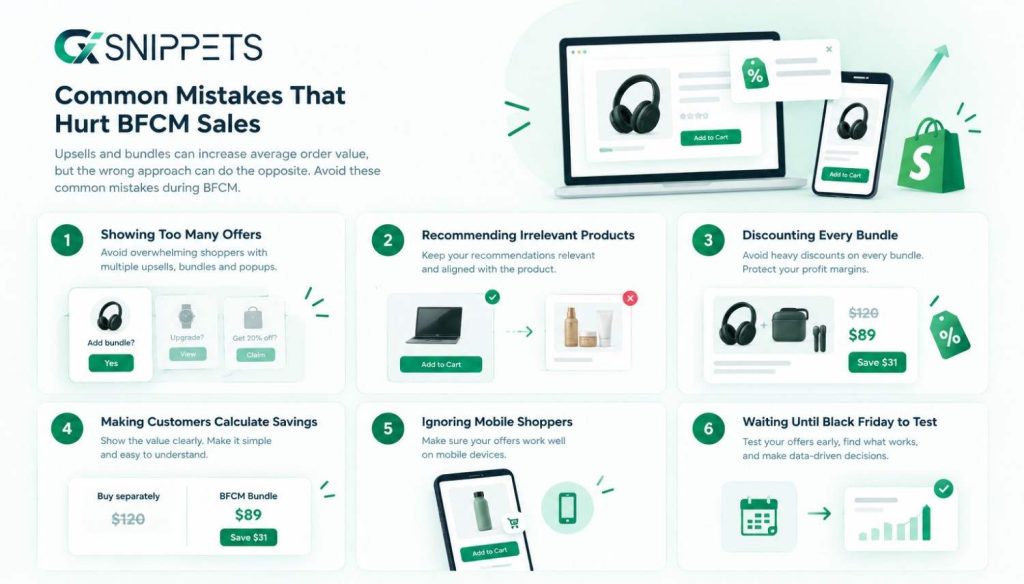
During BFCM, shoppers are dealing with a flood of promotions, so adding more offers isn’t always better.
Here are some common mistakes to avoid.
1. Showing Too Many Offers
Displaying multiple upsells, bundles, pop-ups, and discount messages at once can overwhelm shoppers.
Instead of trying to promote every product, choose the one or two most relevant offers for each stage of the buying journey.
2. Recommending Irrelevant Products
An upsell should make sense alongside the product the customer is buying.
If someone purchases a laptop and receives an unrelated skincare recommendation, the offer adds noise rather than value.
Use purchase history, product relationships, and cart contents to make recommendations more relevant.
3. Discounting Every Bundle
BFCM already comes with heavy discounting. Offering another large discount on every Shopify bundle can quickly reduce your profit margin.
Before creating a bundle, calculate whether the additional products and increased order value actually make the offer profitable.
4. Making Customers Work Out the Savings
A complicated bundle offer can lose its appeal within seconds.
Instead of making shoppers calculate individual prices, show the value clearly:
Buy separately: $120 → BFCM Bundle: $89 → Save $31
The easier the value is to understand, the easier the decision becomes.
5. Ignoring Mobile Shoppers
A large portion of BFCM shopping happens on mobile devices. An upsell that looks great on desktop can become intrusive on a small screen.
Test your Shopify bundles, cart offers, popups, and checkout upsells on mobile before the campaign goes live.
6. Waiting Until Black Friday to Test
One of the biggest mistakes is launching a new upsell strategy for the first time when BFCM traffic is already arriving.
Test your offers beforehand. Identify which products customers frequently purchase together, which upsells get clicks, and whether your offers actually increase average order value without hurting conversions.
How to Measure Success and Maximize BFCM AOV
Adding upsells and Shopify bundles is only half the strategy. To know whether they are actually helping you increase average order value, track how shoppers respond before, during, and after BFCM.
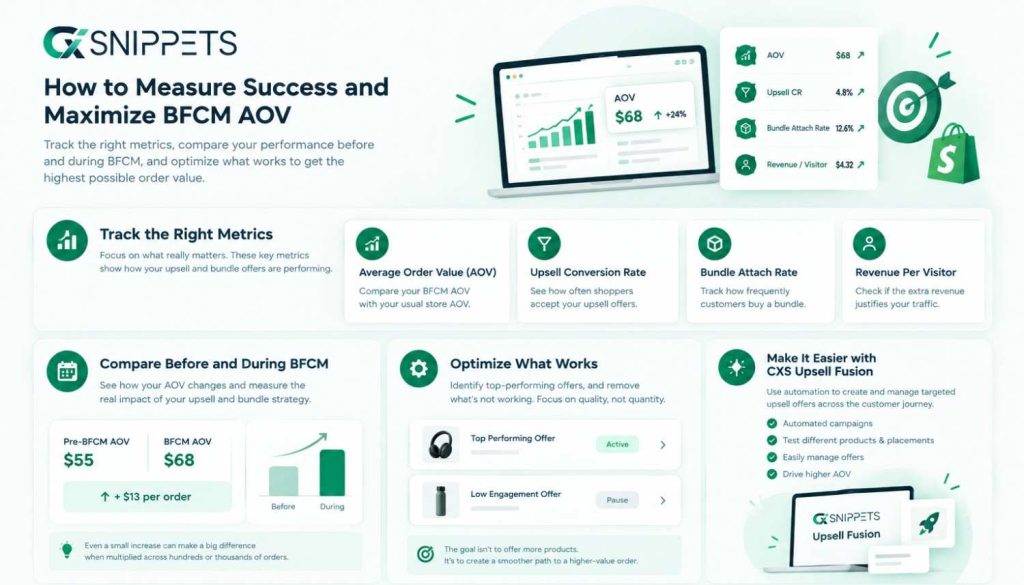
Track the Right Metrics
Focus on these four metrics:
- Average Order Value (AOV): Compare your BFCM AOV with your usual store AOV to see whether customers are spending more per order.
- Upsell Conversion Rate: Measure how often shoppers accept your upsell offers.
- Bundle Attach Rate: Track how frequently customers purchase a bundle when it is offered.
- Revenue Per Visitor: Check whether the additional revenue generated from upsells and bundles justifies the traffic you’re bringing to the store.
Don’t look at AOV alone. If an upsell increases AOV but causes your conversion rate to drop significantly, the offer may not be delivering the overall result you want.
Compare Before and During BFCM
Start with your regular average order value Shopify merchants generate before the sale, then compare it with your BFCM performance.
For example:
- Pre-BFCM AOV: $55
- BFCM AOV: $68
- AOV increase: $13 per order
Even a relatively small increase can become significant when multiplied across hundreds or thousands of orders.
Optimize What Works
Once BFCM begins, identify which upsells and Shopify bundles are generating the strongest results. Don’t be afraid to remove offers that receive little engagement or add friction to checkout.
The goal is not simply to offer more products. It’s to create a smoother path toward a higher-value order.
For Shopify merchants, tools such as CXS Upsell Fusion can simplify this process by helping create and manage targeted upsell offers across the customer journey. Instead of manually testing every offer, merchants can use automated campaigns to experiment with different products, placements, and offers.
Frequently Asked Questions
What is a good AOV increase during BFCM?
There is no universal target for BFCM AOV because it varies by product category, pricing, and customer behavior. A practical goal is to compare your BFCM AOV with your normal baseline and aim for a measurable increase without negatively affecting conversion rates or profit margins.
How can I increase average order value on Shopify?
You can increase average order value on Shopify by using relevant upsells, cross-sells, product bundles, free-shipping thresholds, quantity discounts, and post-purchase offers. The most effective strategy is to recommend products that naturally complement what the customer is already buying.
Are product bundles better than discounts for BFCM?
Product bundles can be more valuable than blanket discounts because they encourage customers to purchase multiple products while giving them a clear value proposition. A well-designed Shopify bundle can increase order size without requiring you to discount every product in your store.
Where should I place BFCM upsells?
The best placement depends on the customer’s buying stage. Product pages work well for upgrades and bundles, cart pages for complementary products, checkout for simple add-ons, and post-purchase pages for additional relevant offers.
How many upsell offers should I show?
There is no fixed number, but fewer relevant offers are generally better than overwhelming customers with choices. During BFCM, focus on one strong recommendation at each stage and make its value immediately clear.
Can upsells and bundles reduce conversions?
Yes. Irrelevant recommendations, excessive popups, complicated offers, or aggressive upselling can create friction and cause shoppers to abandon their purchase. Monitor both AOV and conversion rate to ensure your strategy increases revenue without damaging the shopping experience.
About the Author: Mohd Talib

