

BOGO deals do something interesting to a seasonal shopper’s brain; they feel better about getting something free than simply paying less. When they see the “Buy One Get One Free” sign, their attention shifts from the price to the extra value they’re receiving. And, suddenly, buying the extra product doesn’t feel like spending more; it feels like missing out on the “free” product.
This exact psychological trigger makes BOGO deals the “boss” of all other marketing strategies. With the festive season in full swing, Thanksgiving, Black Friday, Cyber Monday, Christmas, and New Year’s, shoppers are constantly searching for better bargains; BOGO deals can push impulse purchases and encourage them to add more to their carts.
BOGO deals are one of the best marketing strategies if you want to increase the average order value of your Shopify store without going crazy with the price drops.
Quick Facts, Under 30 seconds…
- BOGO deals are an inventory-clearing and average order value (AOV) optimization tool rather than a pure margin-discounting play.
- Pair a slow-moving product as the “Free/Discounted” item when a shopper buys a high-margin, high-demand flagship product.
- Mix-and-match BOGO deals (e.g., “Buy any two items in this collection”) create a scavenger hunt experience.
- Data shows that customers acquired through a BOGO deals campaign have a higher rate of returning for a second full-price purchase if the product is a consumable.
- When presented with a choice between a BOGO deal and a percentage-off deal of the exact same monetary value, three times as many consumers choose BOGO deals.
- BOGO deals hold so much leverage that 50% of shoppers admit they would switch from their preferred brand to a competing brand just to capitalize on a BOGO run.
But successful BOGO deals involve more than just offering a free product. The right product combinations, incentives, and timing can make a significant difference. With solutions like CXS Upsell Fusion, Shopify merchants can also create relevant upselling opportunities and recommend complementary products to encourage additional purchases.
In This Blog, We Will Talk About…
(Jump to the section that interests you the most!)
So, why do seasonal shoppers find BOGO deals so hard to resist, and how can Shopify store owners use these psychological triggers to make holiday promotions more effective?
Let’s explore!
The Psychology Behind BOGO Deals: Why Shoppers Can’t Resist Them
The power of BOGO deals isn’t about getting more or free stuff; it’s about how your customer’s brain processes the extra value when they visit your Shopify store. Understanding the psychological mechanism behind BOGO deals will help you craft BOGO offers that actually click.
Before we proceed, here’s an interesting fact about BOGO deals –
Consumers will overwhelmingly choose a BOGO deal over an economically identical 50% discount because our brains are irrationally hardwired to love the word “free”!
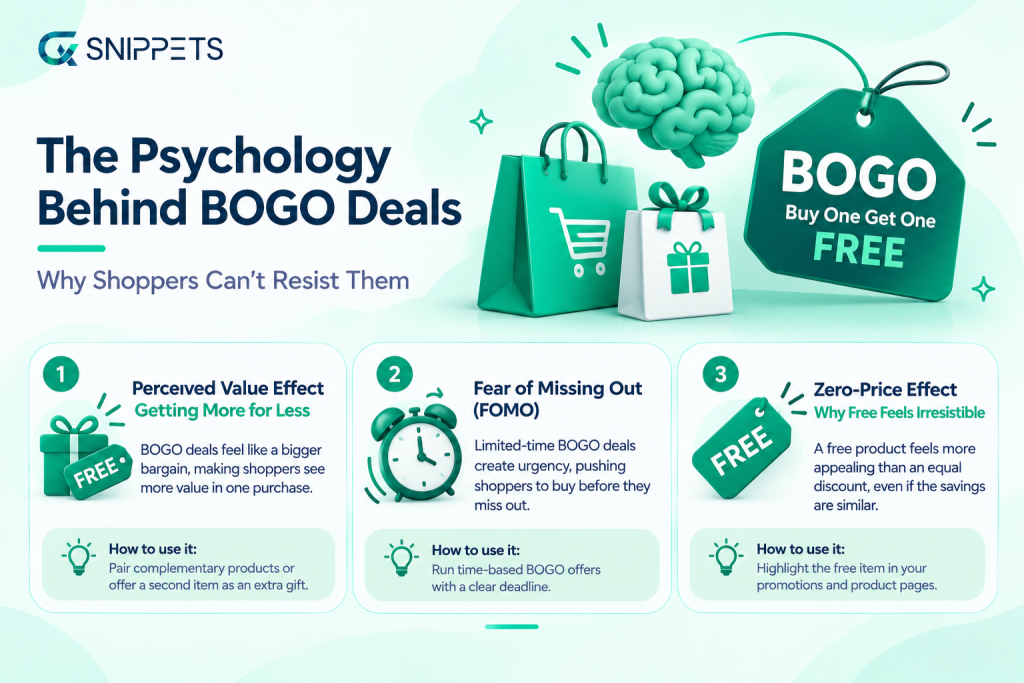
1. Perceived Value Effect: Getting More for Less
Seasonal shoppers don’t always judge a deal by how much money they save. But the word “Free” does something magical to their perception. This is where the perceived value effect comes into play.
BOGO deals make a purchase feel more rewarding because customers get an additional product without paying its full price. For example, a shopper buying a Christmas gift set might be more attracted to a Buy One Get One Free offer than a 50% discount on the same product.
The appeal stems from the feeling of getting more value from a single transaction. During peak holiday sales, when shoppers buy gifts for friends and family, an extra item can make an offer feel even more worthwhile.
2. Fear of Missing Out (FOMO)
Fear of missing out (FOMO) can nudge seasonal shoppers to act quickly when they believe an enticing offer won’t last long. BOGO deals become even more compelling when they’re tied to limited-time holiday campaigns.
For instance, a Shopify store running a Christmas sale that offers a free product with every purchase until December 25 creates a reason for customers to buy before the offer expires.
The possibility of losing out on an attractive offer can make customers less likely to postpone their purchases. Instead of waiting for another sale, they may decide to complete their orders while the offer is still available.
3. Zero-Price Effect: Why Free Feels Irresistible
A major psychological difference between getting a product at a discounted price and getting it for free. The word “free” acts like an emotional switch in the brain rather than just a rational price drop.
The zero-price effect explains why seasonal shoppers can find free products appealing, even when the monetary difference between the two offers is very minimal.
Consider two possible promotions:
- Buy one product and get the second at 50% off.
- Buy one product and get the second absolutely free.
Even if both BOGO deals provide similar savings under certain pricing conditions, the word “FREE” can make the second offer feel more attractive.
Customers often focus on the additional benefit rather than calculating the actual savings. This makes free products especially rewarding during holiday shopping, when shoppers are looking for extra gifts, stocking fillers, and products to share with loved ones.
These were the three leading psychological triggers behind any successful BOGO deals. We will discuss the different kinds of BOGO deals that can result in not only increase your Shopify store’s average order value, but also help you capture your shoppers’ attention beyond the festive hustle and bustle.
5 Types of BOGO Deals That Work During Holiday Shopping
Not all BOGO deals work the same way. There are many factors that contribute to a successful BOGO offer that helps you achieve your holiday sales goals; some of the important factors are –
- The products you sell
- Your profit margins
- Target audience & their shopping preferences
- The perceived value of the BOGO deals
- Timing & duration of the offer
- Relevance of the product combinations.
Merchants can experiment with different BOGO deals and understand what works best for their shoppers, encouraging additional purchases.
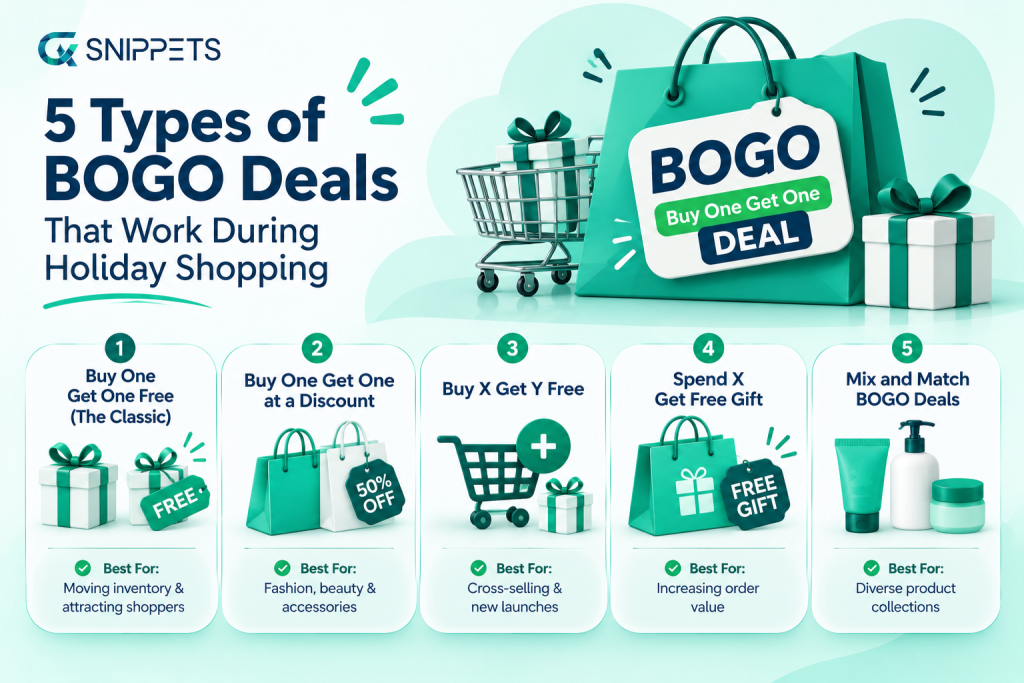
1. Buy One Get One Free (The Classic)
This is one of the most recognized BOGO deals. Customers purchase one product and get another one for free. Its appeal lies in its straightforward approach of getting twice the quantity without paying twice the price.
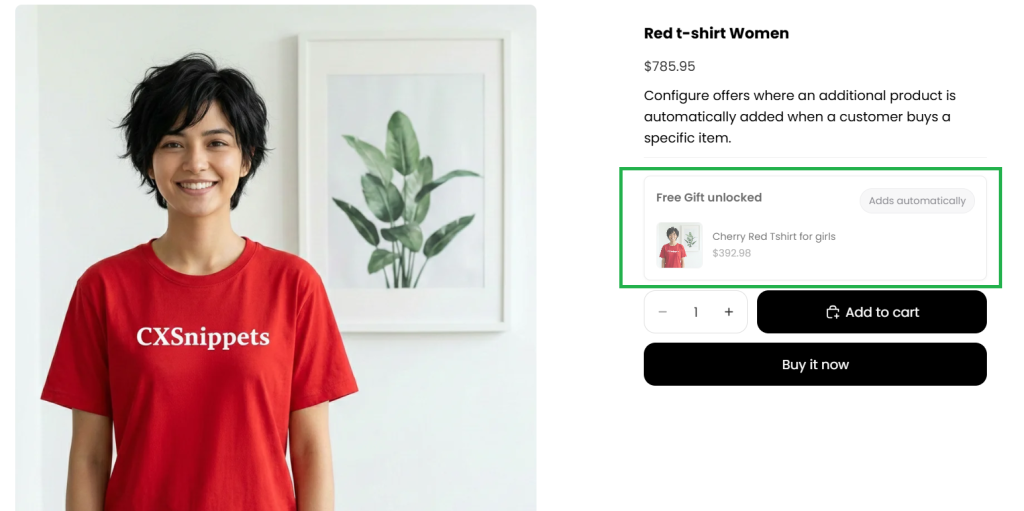
For example, a Christmas gift store could offer a Buy One Get One Free deal on selected products. This allows shoppers to purchase one for themselves and get another for a friend or family member.
2. Buy One Get One at a Discount
The idea behind these BOGO deals is that customers buy one product and get another one at a discounted price. For example, customers who purchase one hoodie can get the second at 50% off.
This encourages seasonal shoppers to purchase more than one item at a time, while allowing store owners to retain some revenue from the additional product. It can also work well for customers buying gifts for multiple people.
3. Buy X Get Y Free
With this kind of BOGO deal, customers receive a free product after purchasing a specific item or quantity. Unlike traditional BOGO deals, the free product doesn’t necessarily have to be identical to the purchased one.
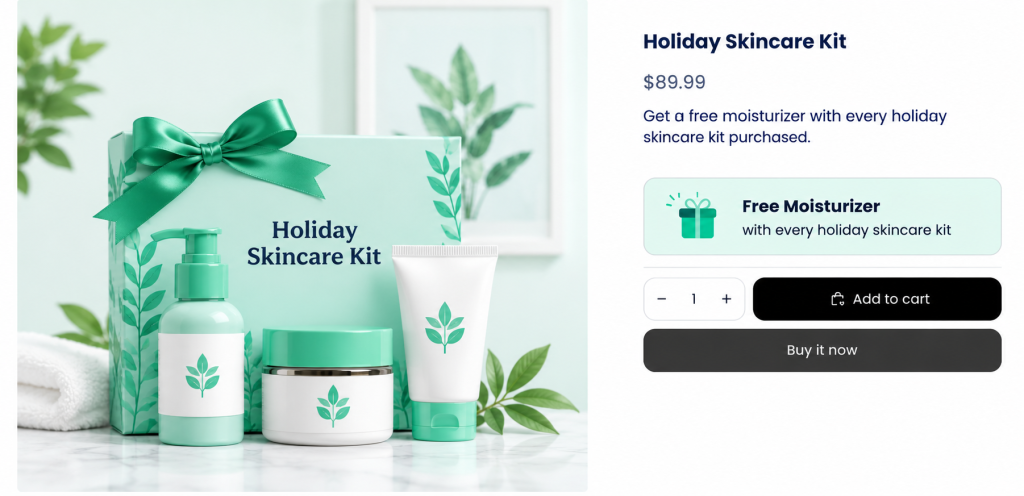
For instance, a skincare store could offer a free moisturizer with every holiday skincare kit purchased. This encourages seasonal shoppers to explore complementary products while making the original purchase feel more valuable.
4. Spend X Get Free Gift
This BOGO-style promotion rewards customers with a free product when they reach a specified spending threshold. For example, a Shopify store could offer a free Christmas gift hamper on purchases worth $100 or more.
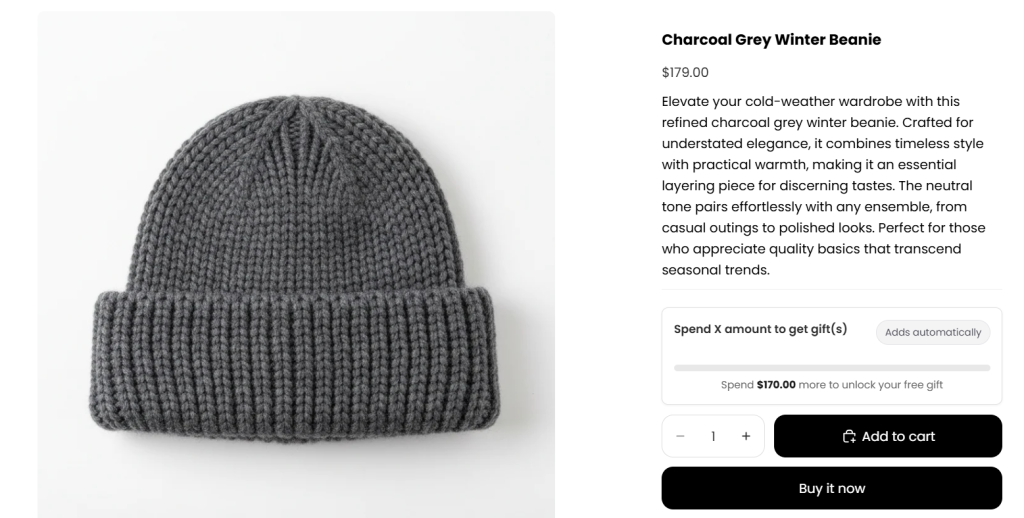
This encourages shoppers to add more products to their carts to unlock the reward, helping merchants increase average order value while making customers feel they’re getting extra value from their purchase.
5. Mix and Match BOGO Deals
This type of BOGO deal allows store owners some flexibility. It allows customers to select products from a specified collection instead of purchasing identical items. For example, a Shopify store could let customers choose any two holiday accessories and receive a third accessory for free.
This flexibility makes the promotion more attractive because shoppers can select products according to their preferences rather than being restricted to a single product combination.
BONUS BOGO DEAL IDEA: Buy More, Save More BOGO Deals!
This kind of offer encourages customers to purchase more units of a product in exchange for higher discounts. Instead of receiving an additional product for free, shoppers unlock better savings as they increase their order quantity.
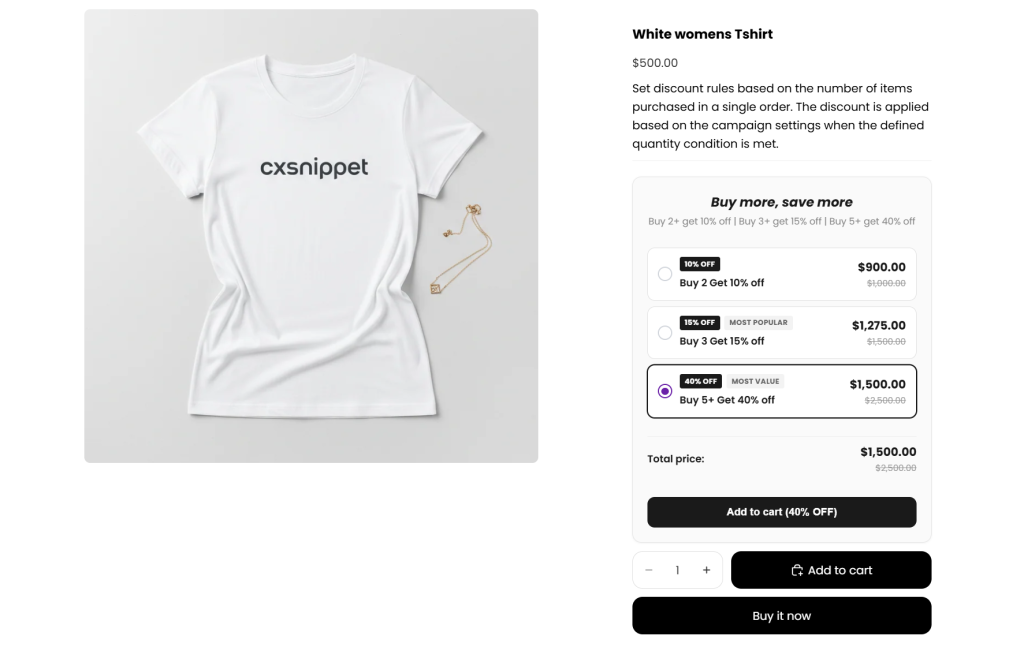
For example, a Shopify store could offer 10% off when customers buy two T-shirts, 15% off when they buy three, and 40% off when they purchase five or more. This gives shoppers an encouragement to increase their order quantity to unlock a better deal. This makes this a “WIN-WIN” for both the store owners and customers. During peak holiday shopping, this strategy works particularly well for customers purchasing gifts in multiples or stocking up on products for the season.
But choosing the perfect BOGO deal is just the first step. To get most of these offers, you need the right tools to put these strategies into action. From encouraging your customers to purchase more to recommending relevant complementary products, the right upselling approach can help you make the most of this festive season rush. This is where CXS Upsell Fusion comes into play, and help Shopify merchants to increase their margins without increasing their prices.
How CXS Upsell Fusion Helps Merchants Make the Most of Holiday Promotions
The holiday season brings countless buyers to your Shopify store, but attracting traffic is just the first step in the holiday marketing checklist. You need to maximize every purchase opportunity, turning random holiday browsers into buyers. Use BOGO deals, product recommendations, upsell offers, discount deals, bundles, or free gifts.
With CXS Upsell Fusion, turn everyday orders into a better buying experience. Set up BOGO deals, upsell and cross-sell offers, and add free gifts to reward loyal customers. These small touches, like BOGO, make your customers feel valued and give them a reason to come back.
Let us see which of its many features can be used to make this festive season profitable for your store –
CXS Upsell Fusion Feature |
How It Supports Holiday Sales? |
Holiday Campaign Example |
|---|---|---|
| BOGO Deals | Create Buy One Get One promotions with free or discounted products. | Offer a free Christmas accessory with selected purchases. |
| Free Gifts | Reward customers with free products based on purchase conditions, quantity, or spending. | Offer a free gift hamper on orders above $100. |
| Product Bundles | Combine complementary products into attractive bundles or mix-and-match offers. | Create Christmas gift bundles with related products. |
| Frequently Bought Together | Recommend products that customers commonly purchase together. | Suggest matching accessories with holiday outfits. |
| Quantity Breaks | Offer tiered discounts to encourage customers to purchase more units. | Offer 10% off two items and 15% off three items. |
| Cart Upsells | Display relevant product offers during the cart journey. | Recommend additional stocking fillers before checkout. |
| Post-Purchase Upsells | Present additional product offers after customers complete their purchases. | Recommend complementary gifts after a Christmas order. |
| Campaign Scheduling | Schedule promotional campaigns around specific dates and times. | Run separate campaigns for Black Friday, Cyber Monday, and Christmas. |
| Analytics and Reporting | Track campaign performance and understand how offers contribute to sales. | Identify which holiday promotions generate more additional purchases. |
With CXS Upsell Fusion, Shopify merchants can automate these BOGO deals and different upsell campaigns based on products, cart contents, and customer behavior. Create different kinds of offers using features like post-purchase upsell, cart page upsell, frequently bought together, mix & match bundles, BOGO, and cart value discounts. Set conditions based on cart value, product quantity, or specific collections to control how each campaign works.
Are You Ready To Launch Your First Upsell Offer?
Conclusion
BOGO deals work because they tap into the way customers’ minds perceive value, rewards, and savings. During the holiday season, when shoppers are actively searching for good discounts and offers, the right BOGO deals can make their purchase feel more valuable, while also encouraging them to add extra products to their carts.
But as discussed earlier, the perfect BOGO offer doesn’t mean simply offering a “FREE” product to customers. Store owners need to choose a relevant complementary product, communicate the offer clearly, specify the duration of the offer, understand their customer preferences, and create a sense of urgency without compromising their shopping experience.
With CXS Upsell Fusion, Shopify merchants can put all the mentioned strategies into action through promotional BOGO deals, product recommendations, and other upselling opportunities.
The key is to combine the right incentives with the BOGO deals, which helps store owners increase their average order value without customers feeling a pinch in their pockets!
Happy BOGO Selling! Here’s to EXTRA VALUE for your CUSTOMERS and EXTRA PROFITS for you!
Frequently Asked Questions
1. What is a bogo deal?
A BOGO deal stands for “Buy One, Get One” (often meaning a Buy One, Get One Free offer) and is a common B2B promotion where purchasing an item unlocks a second item for free or at a discounted price
2. How do I know if BOGO offers are cannibalizing my full-price sales?
The key is to track your conversion rates by customer segments. If a certain segment of customers (those who typically convert quickly) are actively seen waiting for the BOGO deals that you’re offering, it directly means you are “overdiscounting.” The solution? Focus your BOGO deals on customers’ behavioral segments that show hesitation, such as extended browsing time, multiple visits, or cart abandonment patterns.
3. Should I offer identical products or complementary items in my BOGO deals?
Yes, it is ideal to offer identical products or complementary items. Pair complementary products or offer a second item as an additional gift. Make the offer’s value clear so shoppers can easily understand what they’re getting.
4. What is a bogo sale?
A Bogo sale stands for “Buy One, Get One”, where when customers buy one item, they get the second one for free. This is a common marketing strategy followed by a lot of eCommerce brands during holiday sales like Black Friday, Cyber Monday, Thanksgiving, and Christmas.
About the Author: Muskaan Sabarwal

