

Running a Shopify store in 2026 means competing in one of the most crowded eCommerce landscapes ever recorded.
Paid ads are expensive. Organic reach is shrinking. And acquiring a new customer costs five times more than keeping an existing one.
That is why a Shopify loyalty program is no longer optional, it is a core growth lever. Stores with structured reward programs consistently see 20–30% higher repeat purchase rates, stronger customer lifetime value, and significantly lower acquisition costs over time.
This guide covers everything: how loyalty programs work, what types exist, which strategy fits your store, what pitfalls to avoid, and how to launch a program that drives real revenue, not just points balances nobody ever redeems.
Table Of Contents
- What Is a Shopify Loyalty Program?
- Comparison Find The Best Zoho CRM Alternatives
- Types of Shopify Loyalty Programs
- How to Build a Shopify Loyalty Program
- Which Shopify Loyalty App To Use
- Guide to Launch Your First Program in 48 Hours
- Common Mistakes That Kill Loyalty Programs
- Loyalty Program Trends in 2026
- Conclusion
What Is a Shopify Loyalty Program?
A Shopify loyalty program is a structured system that rewards customers for actions that benefit your store, purchases, referrals, reviews, social shares, account sign-ups, and more. Customers accumulate points or credits, then redeem them for discounts, free products, or exclusive perks.
Done well, a shopify loyalty program converts one-time buyers into brand advocates. Done poorly, it becomes a discount machine that trains customers to wait for coupons instead of buying at full price.
The difference between the two comes down to strategy, not just the app you install.
Why Loyalty Programs Matter More Than Ever in 2026
Several forces have converged to make customer retention more critical than at any point in recent eCommerce history.
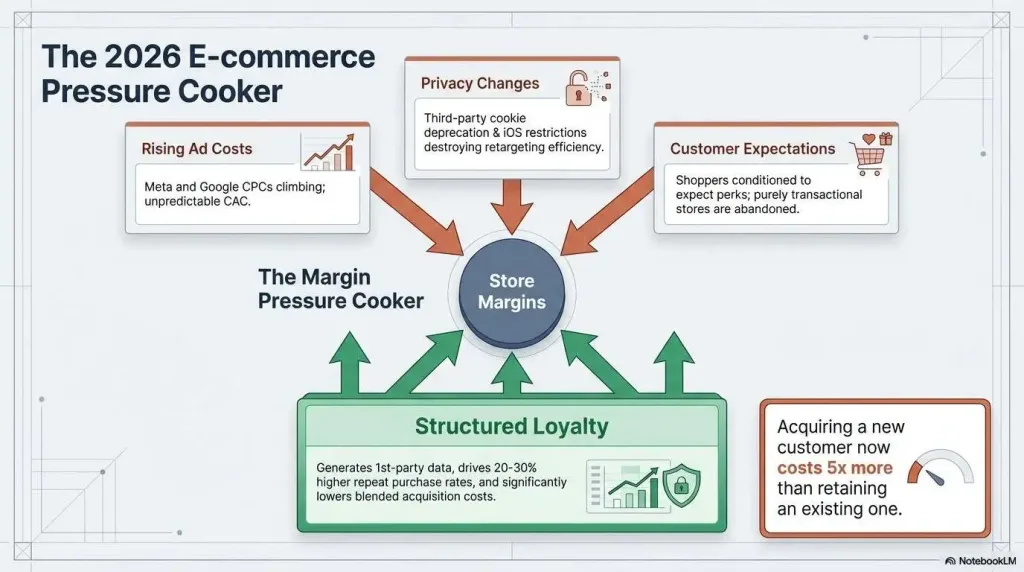
- Rising ad costs: Meta and Google CPCs have climbed every year. Brands that depend exclusively on paid acquisition face compressed margins and unpredictable CAC.
- Privacy changes: Third-party cookie deprecation and iOS tracking restrictions have made retargeting harder and less precise. First-party data, which loyalty programs collect naturally, is now a genuine competitive asset.
- Customer expectations: Shoppers increasingly expect to be rewarded. Major retailers have conditioned consumers to look for loyalty perks before choosing where to buy. A store without a program feels purely transactional.
- Subscription and recurring revenue growth: More Shopify stores are moving toward subscription models. Loyalty tiers, exclusive subscriber benefits, and reward multipliers for recurring buyers are powerful tools in this model.
The math is simple: improve your repeat purchase rate by 5% and your revenue grows by more than 25% without adding a single new customer to your acquisition funnel.
Types of Shopify Loyalty Programs
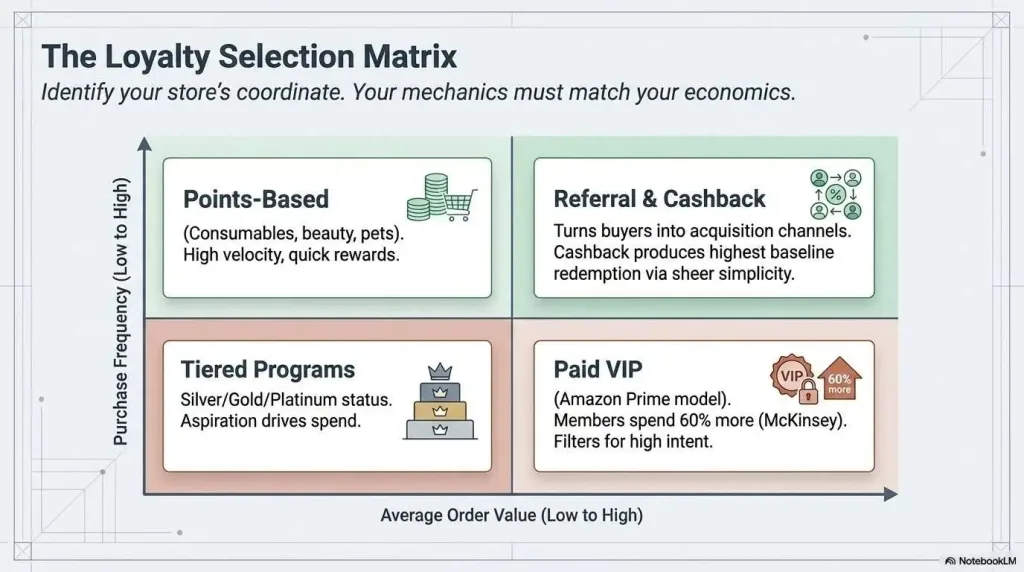
Not all loyalty structures work equally for every store. The right model depends on your product, average order value, purchase frequency, and customer profile.
1. Points-Based Programs
The most common and recognizable model. Customers earn points per dollar spent and redeem them for discounts or free products.
- Best for: High-frequency, lower-AOV stores, beauty, consumables, supplements, pet supplies.
- Example: Earn 5 points per $1 spent. 500 points = $5 off your next order.
- Risk: Points liability can accumulate quickly if you do not manage redemption thresholds and expiry policies carefully from the start.
2. Tiered Programs
Customers unlock escalating benefits as they reach annual or lifetime spending thresholds, Silver, Gold, Platinum, and similar structures.
- Best for: Mid-to-high AOV stores where big spenders deserve recognition, status, and differentiated treatment.
- Example: Silver (0–$500/year): 5% back. Gold ($500–$1,500): 8% back + free shipping. Platinum ($1,500+): 12% back + early product access.
- Why it works: Tier status creates genuine aspiration. Customers spend more to reach the next level, even when the financial difference is relatively small. Status is a powerful motivator.
3. Paid VIP Membership Programs
Customers pay a one-time or recurring fee to access exclusive benefits, think a brand-specific version of Amazon Prime.
- Best for: Stores with strong product-market fit and a loyal base willing to invest in the relationship.
- Example: $49/year for free shipping on all orders, 15% member pricing, and early access to new product drops.
- Why it works in 2026: Customers who pay for membership spend an average of 60% more than non-members, according to McKinsey data. The act of paying signals high intent and filters for your most valuable buyers.
4. Referral Programs
Existing customers earn rewards for bringing in new buyers. This is technically a hybrid loyalty and acquisition tool.
- Best for: Any store with a passionate customer base and a product people naturally recommend.
- Example: Refer a friend, both of you get $10 in store credit on your next order.
- Key metric: Track referral conversion rate (invites sent vs. purchases completed), not just the number of referrals issued.
5. Cashback Programs
Instead of points, customers earn a percentage of their spend back as store credit, automatically applied or available on demand.
- Best for: Stores where customers find points systems confusing, or where brand simplicity is a core value.
- Example: Earn 5% cashback on every order, redeemable automatically from the next purchase.
- Advantage: Cashback feels more tangible than abstract points and consistently produces higher redemption rates.
How to Build a Shopify Loyalty Program That Actually Drives Revenue
Choosing a platform is the easy part. The strategy behind the program determines whether it drives real growth or quietly runs in the background with zero impact.
Step 1: Define What Loyalty Means for Your Specific Store
Before configuring a single point multiplier, answer these questions honestly:
- What is your average purchase frequency per customer per year?
- What percentage of your current revenue comes from repeat buyers?
- What customer actions, beyond purchases, do you want to actively incentivize?
A store selling mattresses (one purchase per decade) needs a referral-heavy program. A coffee brand selling monthly subscriptions needs a tier system with recurring purchase bonuses. A fashion brand needs early access and exclusivity built in.
Your answers should drive every decision that follows.
Step 2: Set a Sustainable Point Value
The most common early mistake is setting point values that destroy margins without realizing it.
Start with this formula: “Earn rate × Redemption rate = Effective discount percentage”
If you give 10 points per $1 spent and 100 points = $1 off, your earn rate is 10%. If 40% of customers actually redeem, your effective cost is 4% per order. Make sure your margin supports this before you launch.
A safe starting target is a 2–5% effective discount on redeemed points, adjusted upward only once you have real redemption data.
- Account creation (one-time bonus)
- Email or SMS opt-in (one-time bonus)
- Leaving a verified product review
- Following on social media
- Sharing a post or tagging your brand
- Birthday purchases
- Referral conversions
These touchpoints transform your shopify loyalty program from a discount mechanism into a full engagement engine.
They also give lower-spending customers a path to meaningful rewards, which broadens participation significantly.
Step 4: Create Urgency Without Anxiety
Points that never expire reduce urgency to redeem. Points that expire too fast feel punitive and erode trust.
Best practice: Set a 12-month rolling expiry. Points expire 12 months after the last earning activity, not 12 months from issuance. This rewards active customers while naturally sunsetting dormant accounts without alienating them.
Step 5: Promote the Program Actively and Repeatedly
A shopify loyalty program nobody knows about earns nothing. Promotion is not optional, it is part of the launch.
Channels to activate:
- Post-purchase email: Announce the program immediately after the first purchase while buying intent is highest
- Welcome series: Introduce earning opportunities across your full onboarding flow
- Persistent site widget: Visible on product pages, cart, and checkout
- Dedicated landing page: A full program explainer for new visitors searching for loyalty perks
- SMS campaigns: High open-rate channel for tier milestone announcements and point expiry reminders
Most stores under-promote their shopify loyalty program for the first 6 months and then blame the app for poor results. The app is not the problem.
Step 6: Measure What Actually Matters
Vanity metrics, total members enrolled, total points issued, feel good but tell you nothing about ROI. Track these instead:
| Metric | Why It Matters |
|---|---|
| Redemption rate | Low rate means the program is invisible or unappealing |
| Repeat purchase rate: members vs. non-members | The core program effectiveness signal |
| Average order value: members vs. non-members | Is the program lifting basket size? |
| Points liability as % of revenue | Financial health check every month |
| Tier upgrade velocity | How quickly customers are reaching higher tiers |
| Referral conversion rate | Quality signal for word-of-mouth loop |
Review these monthly in your first quarter. Adjust earn rates, redemption thresholds, or promotion strategy based on what the data shows, not gut feel.
Which Shopify Loyalty App Should You Use?
There are dozens of loyalty apps in the Shopify App Store. The right choice depends on your store size, technical resources, and budget. When evaluating options, look for:
- Simple and intuitive setup without needing developer support
- Flexible point earning rules for purchases and non-purchase actions
- VIP Tiers and VIP program support
- Referral program built in
- Clean, mobile-optimized customer-facing widget
- Transparent pricing that does not scale aggressively with order volume
- Strong support and documentation
Ready to Launch Your Shopify Loyalty Program?
Step-by-Step: Launch Your First Program in 48 Hours
If you want to move fast, here is the minimum viable launch plan:
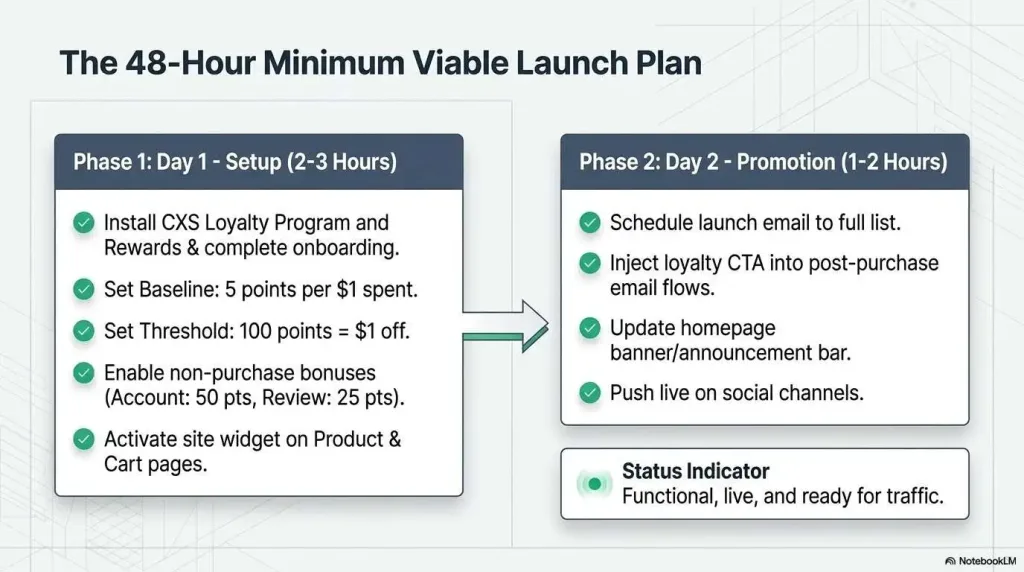
Day 1, Setup (2–3 hours)
- Install CXS Loyalty Program and Rewards and complete onboarding
- Set your earn rate (start at 5 points per $1 spent)
- Set your redemption threshold (100 points = $1 off is simple and clean)
- Enable account creation bonus (50–100 points)
- Enable review bonus (25–50 points per verified review)
- Activate the site widget on product and cart pages
Day 2, Promotion (1–2 hours)
- Schedule a launch email to your full customer list explaining the program
- Add a loyalty CTA to your post-purchase email flow
- Update your homepage banner or announcement bar
- Post on social channels
That is a functional program ready for real traffic. Optimize from there based on what the data shows in the first 30 days.
Common Mistakes That Kill Loyalty Programs
Making redemption too complicated. If customers need to do math to understand their points balance or redemption options, most will not engage. Simplicity is a feature.
No expiry policy. Uncapped, non-expiring points create compounding financial liability that can quietly become a serious balance sheet problem within 18–24 months.
Launching without a promotion plan. App installed, email sent to nobody. This is the single most common reason shopify loyalty programs fail to gain any traction in the first 90 days.
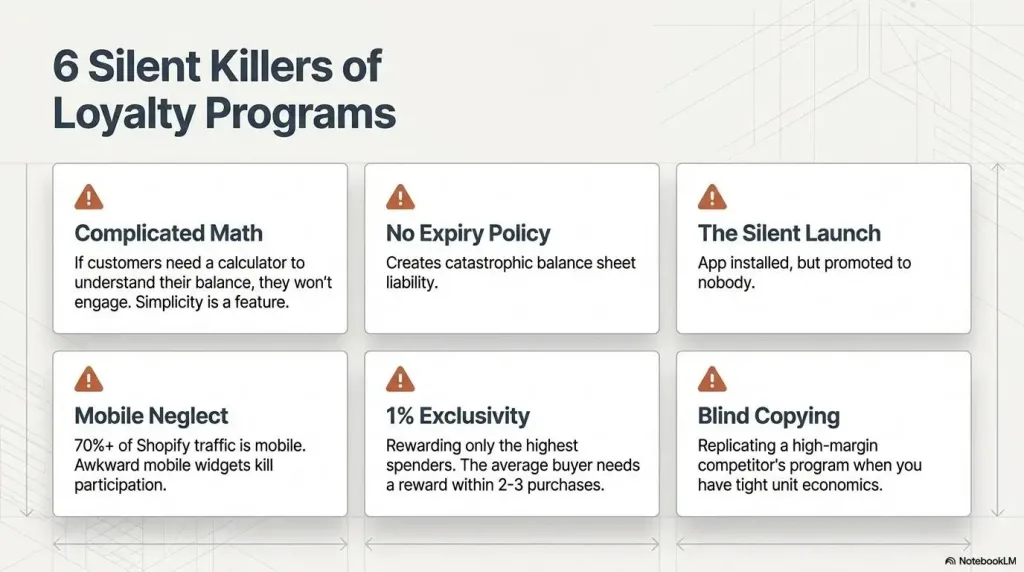
Ignoring the mobile experience. More than 70% of Shopify traffic is mobile. If your loyalty widget is awkward on a phone, the vast majority of your customers will never interact with it.
Rewarding only the top 1% of spenders. If only your highest-value customers ever reach a meaningful reward threshold, everyone else ignores the program entirely. Design your earn curve so the average customer reaches a real reward within two to three purchases.
Copying a competitor’s program without understanding their margin. What works at scale for a market leader with high margins may actively hurt a smaller store with tighter economics.
Loyalty Program Trends Shaping 2026
-
- AI-personalized reward offers: Several platforms are beginning to use purchase history and predicted LTV to dynamically adjust point multipliers, offering higher earn rates to high-value customers who show churn signals.
- Social commerce integration: Rewarding customers for purchases made through TikTok Shop or Instagram Checkout, not just the main Shopify storefront.
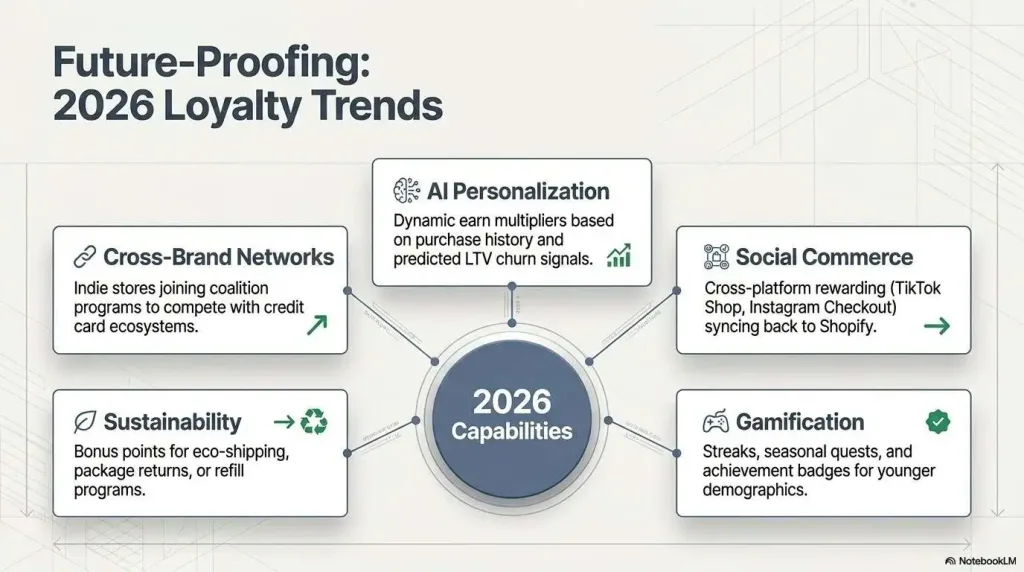
- Gamification layers: Streaks, challenges, seasonal quests, and achievement badges layered on top of traditional points programs. Particularly effective for younger demographics who expect app-like engagement.
- Sustainability-linked rewards: Customers earn bonus points for choosing eco-friendly shipping, returning packaging, or opting into product refill programs. Strong brand alignment signal for sustainability-focused audiences.
- Cross-brand loyalty networks: Smaller independent stores are beginning to join coalition programs where points can be earned and redeemed across multiple brands, directly competing with credit card reward ecosystems.
Final Thoughts
A well-built Shopify loyalty program is one of the highest-ROI investments a store owner can make. It compounds over time, every repeat purchase deepens the relationship, increases lifetime value, and reduces your dependence on expensive paid acquisition.
But the app is only 20% of the equation. The earn rate, tier structure, promotion plan, and measurement framework you build around it is the other 80%.
Start simple. Launch a clean points program with a clear earn-and-redeem ratio. Add three to five non-purchase earning opportunities. Promote it in your post-purchase email flow. Measure redemption rate and repeat purchase rate every month. Adjust and iterate.
The stores winning on retention in 2026 are not running the most complex loyalty programs. They are running programs their customers understand, participate in, and recommend to others.
Build for participation first. The revenue follows.
Are You Ready to Turn One-time Buyers into Loyal Repeat Customers?
About the Author: Mohd Talib

