

Let us understand the need to increase shopify aov with the help of a story that plays out in Shopify dashboards every single day.
A store owner doubles their ad spend. Traffic jumps 40%. Revenue goes up — but barely. Margins get worse. They double down again. Same result. They’re running faster just to stay in place. Then they look at a different number. Not sessions. Not conversion rate. Just one metric: how much each customer is spending per order.
They add a bundle. A free shipping threshold. A post-purchase upsell on the thank you page. Two weeks later, revenue is up 22%, with the same traffic. That’s what happens when you focus on AOV instead of just acquisition. And in 2026, with Meta CPCs climbing and organic reach shrinking, it’s the lever that separates profitable Shopify stores from ones that are just busy.
This guide covers everything — the benchmarks, the tactics, the full funnel, and the mistakes that quietly kill results.
Let’s get into it
In This Blog, We Will Talk About…
-
- First, Do You Actually Have an AOV Problem?
- Why AOV Is the Highest-Leverage Number in Your Business
- 6 Levers That Actually Increase AOV
- The Full AOV Funnel — How It All Connects?
- The AOV vs. Conversion Rate Balance (Most Guides Ignore This)
- Common Mistakes That Quietly Kill Results
- Your 48-Hour Launch Plan
- Final Word
(Jump to the section that interests you the most!)
First, Do You Actually Have an AOV Problem?
Before jumping into tactics, you need to know where you stand. Most store owners skip this step and end up optimizing something that wasn’t broken
AOV formula: Total Revenue ÷ Total Orders = Average Order Value
Pull your last 90 days. Now compare it to your industry:
| Industry | 2026 AOV Range |
|---|---|
| Furniture & Home Decor | 180–220 |
| Electronics | 150–200 |
| Jewelry | 120–160 |
| Sports & Outdoors | 95–130 |
| Health & Supplements | 80–100 |
| Fashion & Apparel | 75–105 |
| Beauty & Skincare | 55–75 |
| Pet Supplies | 55–75 |
| Food & Beverage | 45-65 |
If you’re below your industry median, you have a structural problem. Your offer architecture isn’t working. If you’re at median, there’s meaningful room to move toward the top quartile.
And if you’re already in the top 25%?
The goal shifts to protecting AOV while keeping conversion rate healthy. One more thing worth knowing: your traffic source shapes your AOV significantly. Email and direct traffic consistently produce 85–120 AOV.
Paid social sits at 50–70; those are impulse buyers with lower intent. If most of your traffic is coming from TikTok or Meta ads, your AOV ceiling is lower than you think, and bundles become even more important.
Why Aov Is the Highest-Leverage Number in Your Business?
Traffic costs more every year. That’s just reality.
But here’s what makes AOV different from every other growth metric: the cost base doesn’t change. You’ve already paid to acquire the customer. The fulfillment cost is fixed—packaging, shipping, customer service, all the same. Every extra dollar of AOV drops almost entirely to the bottom line.
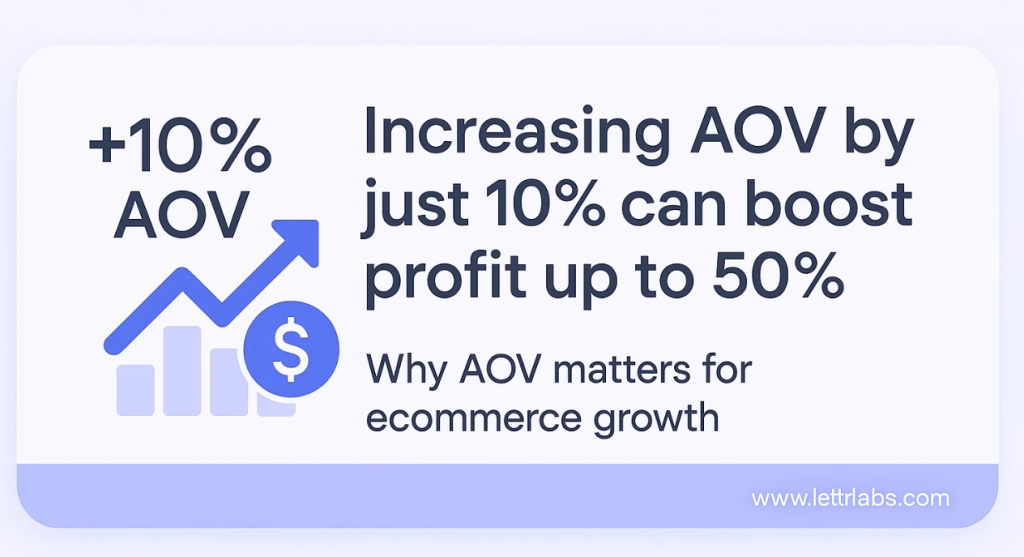
Source: lettrlabs
AG1 (Athletic Greens) understood this years before most DTC brands did. Their subscription model was built around AOV from day one — starter kits, bundle pricing, travel packs.
Their average first order isn’t a single canister. It’s a bundle with accessories. That’s not accidental product design. That’s deliberate AOV architecture.
Stores that get this right don’t just have higher revenue. They have better economics on every single order.
6 Levers That Actually Move AOV
1. Pre-Purchase Upsells — On the Product Page
Want to replace Amazon’s most effective upsell tactics? Displaying “Frequently bought together items” is a proven way to suggest items that might go well together to increase the cart size of your customers.
When shoppers see that others have purchased certain combinations of products, like a laptop with a sleeve and wireless mouse, they’re more likely to add those extra items to their own cart. This is human psychology when it comes to online shopping.
This not only builds trust and convenience but also subtly nudges the customers to increase their cart value without creating any additional pressure.
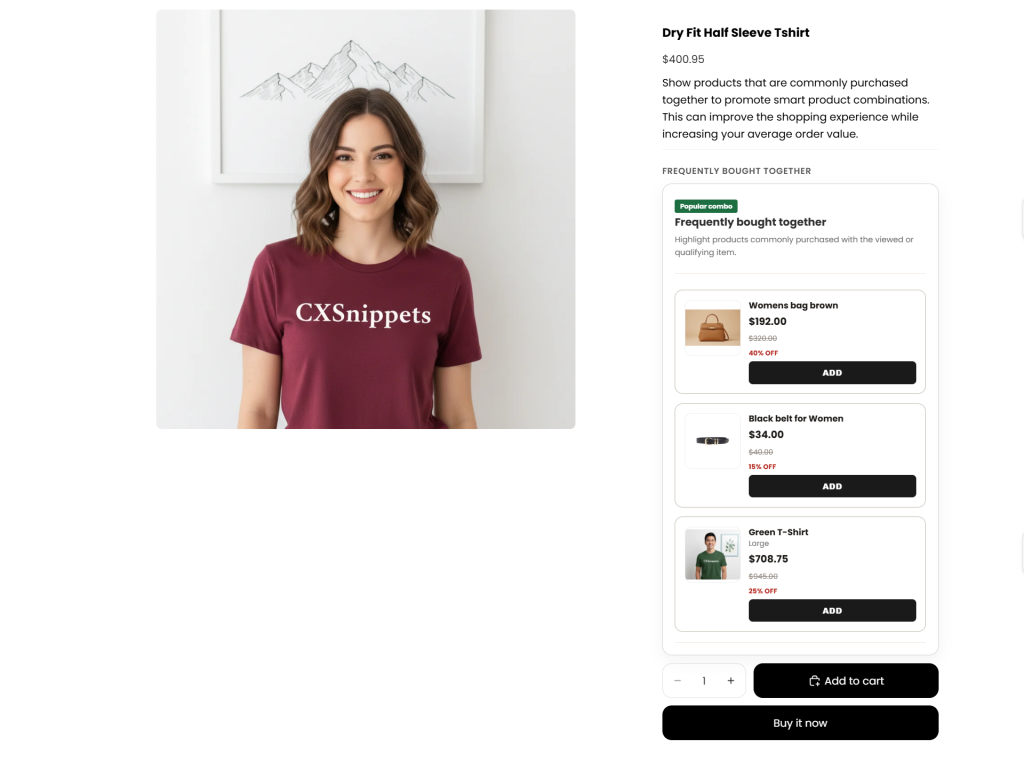
Gymshark does this quietly but effectively. When you’re on a leggings product page, you’re shown the matching sports bra at a slight saving before you add anything to cart.
It’s the same product family, same aesthetic, obvious pairing. The customer doesn’t feel sold to — they feel like they found a deal.
Where it lives: Just below the Add to Cart button on the PDP.
What converts:
- Premium or larger version of the same product (“upgrade to 500ml for $4 more”)
- Quantity upgrade at a per-unit discount
- Extended warranty or protection plan
- Personalisation add-on
Well-placed PDP upsells convert at 8–15% and lift AOV by 10–20% — with zero disruption to the core purchase flow. The rule is simple: relevance beats everything else. An irrelevant upsell doesn’t just fail to convert — it creates doubt about the store itself.
2. Cross-Sells — In the Cart
Cross-sells are complementary products, not upgrades. They work at the cart stage, when the customer’s buying decision is already made, and they’re just reviewing before checkout.
Think of how Beardbrand handles this. Buy a beard oil, and by the time you’re in the cart, you’re looking at a suggested wooden comb and a balm. All three are under $30 each. Adding two of them feels natural — not pushy. The AOV lift on a single product category becomes a grooming kit.
Cart cross-sells convert at 5–12% when the suggestion is genuinely contextual. The trigger question to ask: “What does a customer need to get the most out of what they just bought?” Answer that honestly, and you’ve got your cross-sell.
One format that consistently outperforms others: the slide-out cart drawer with a single “You might also need” suggestion — not a grid of eight products. One suggestion. One decision.
3. Product Bundles — The Highest AOV Lever Available
Stores that implement product bundles well see 20–35% AOV lift. That’s the biggest single-tactic number available anywhere in this list.
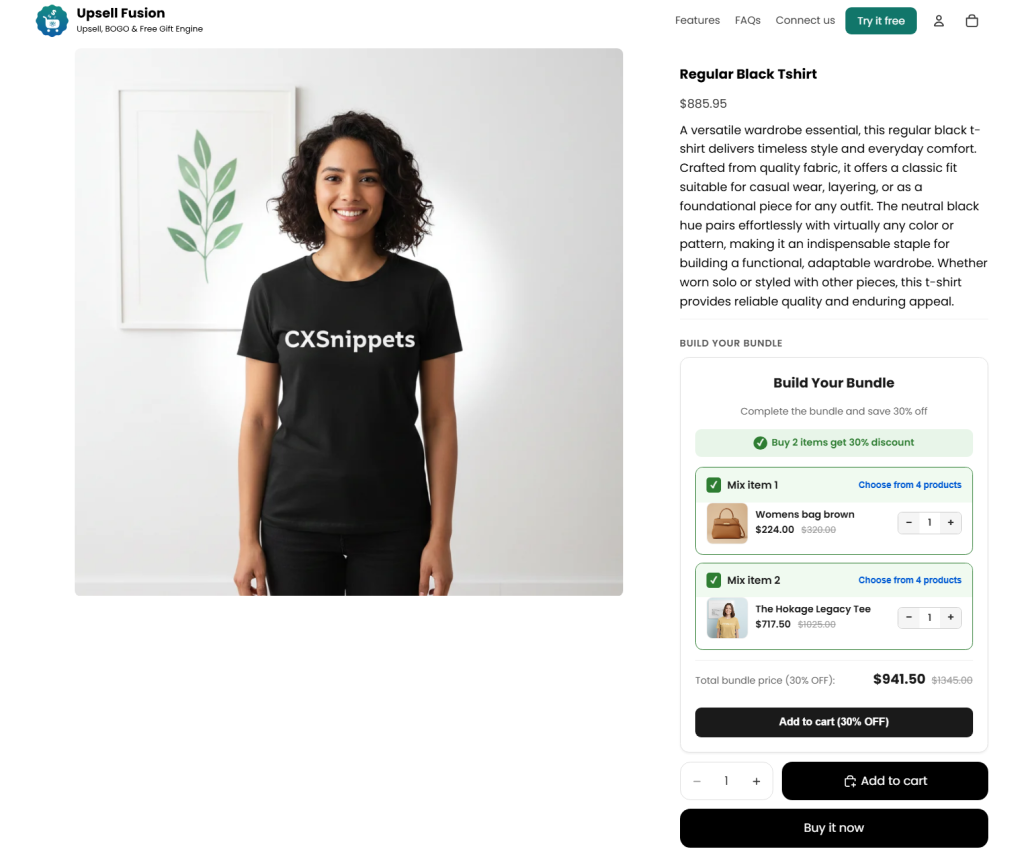
Bundles work because they reframe the purchase. Instead of buying one item, the customer buys an outcome. Pura Vida Bracelets built an entire brand around this — their bundles are marketed as gift sets and “starter collections,” not discounts. The perceived value goes up even as the unit price comes down slightly.
The four bundle types worth knowing:
- Fixed Bundle: Pre-built combination at one price. Best for gift sets, starter kits, seasonal products. Lowest friction, fastest to set up, works well for gifting occasions where the customer wants one decision.
- Mix & Match Bundle: Customer picks N items from a curated pool and unlocks a discount at a quantity threshold. Works brilliantly for fashion, skincare, and food brands with wide catalogs. More engaging, slightly more setup.
- Quantity Break: Buy 2 save 10%, buy 3 save 15%, buy 5 save 20%. The supplement industry lives here. If you sell anything consumable — coffee, protein, skincare, pet food — this is your most powerful tool. It extends purchase cycles and lifts LTV alongside AOV.
- Bundle + Gift: Buy X, get a gift. Protects the perceived value of the main product while adding a tangible incentive. Works especially well during gifting seasons.
Run the margin math before you launch :
(Bundle revenue) − (COGS of all items) − (Discount) − (Fulfillment cost) = Net margin per bundle
If net margin per bundle is lower than your standard order margin, the bundle is destroying profit even as it inflates AOV. Calculate it. Don’t assume.
4. BOGO — The Highest-Converting Promotion Format
“Free” is the most powerful word in retail. That’s not an opinion — it’s decades of behavioural economics research, and it shows up clearly in eCommerce conversion data.
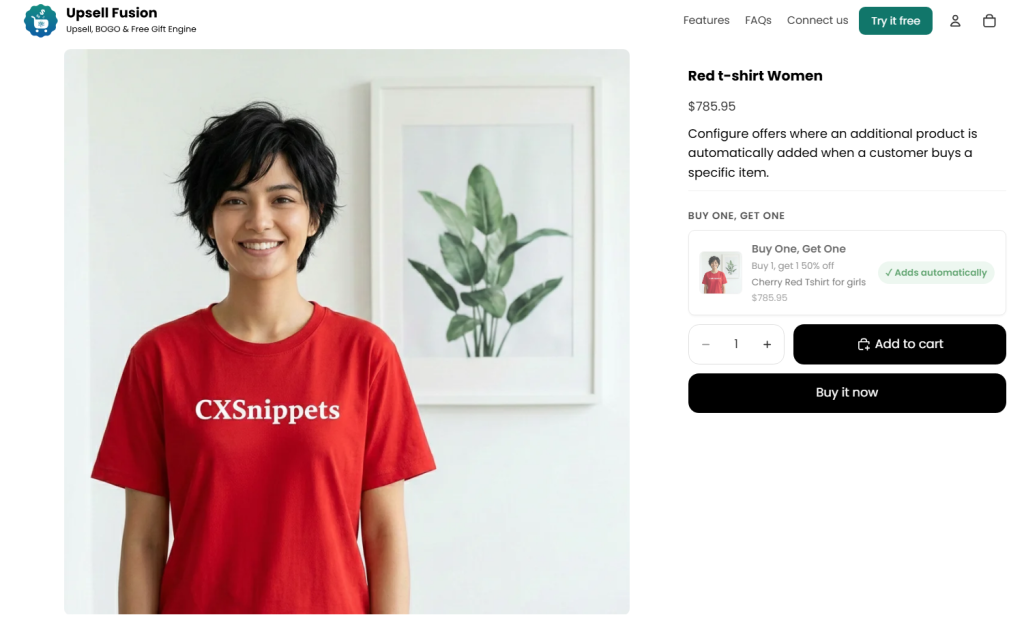
BOGO converts at rates that straight percentage discounts can’t match, because the psychology is different. 50% off feels like a deal. Buy one get one free feels like getting something for nothing — even when the math is identical.
The BOGO variants and when to use them:
- Buy 1 Get 1 Free: Strongest conversion, most margin pressure. Only viable on products with 60%+ gross margin. Beauty, supplements, digital products.
- Buy 1 Get 1 50% Off: Better balance. Works across more product categories without destroying margin.
- Buy 2 Get 1 Free: Drives three-unit orders. Perfect for consumables and gifting. The customer feels like a smart shopper; you move three units at still-healthy margin.
- Buy X Get a Free Gift: Protects the main product’s perceived value entirely. The “gift” can be a low-COGS item — a travel size, a sample, a branded accessory. High conversion lift, manageable cost.
The margin rule for BOGO: For Buy 1 Get 1 Free to break even, your gross margin must be at least 50% per unit. If it’s not, you’re losing money on every BOGO conversion. Do the math before the campaign goes live.
And always, always, cap it. Open-ended BOGO trains customers to never pay full price. Run it for 5–7 days with a visible countdown, and it creates urgency. Run it indefinitely, and it becomes your new pricing floor.
5. Free Shipping Threshold — The Easiest Win in This List
This one takes 20 minutes to set up and consistently delivers 15–25% AOV lift. It’s the most underutilised tactic in eCommerce given how simple it is.
Set your free shipping threshold at 15–20% above your current AOV.
If your current AOV is $65, the threshold goes at $75–$80
That gap is real enough to motivate action and close enough to feel achievable. Customers will genuinely add items to reach it — and they’ll feel good about doing it.
The UX detail that makes or breaks this: show the gap dynamically in the cart drawer. “You’re $11 away from free shipping” with a progress bar. That one element, in Shopify cart tests, has lifted AOV by 10–18% on its own — before any upsell or bundle is factored in.
6. Post-Purchase Upsells — The Most Overlooked Real Estate in Shopify
The thank you page is where most stores put a generic “your order is confirmed” message and leave it at that.
That’s a missed opportunity.
The moment right after purchase is when customer trust is at its absolute peak. The payment’s done. The anxiety of checkout is gone. The excitement of getting something new is at its highest. A well-placed, one-click post-purchase upsell on the thank you page converts at 15–25% — often higher than any other placement in the entire funnel. The offer needs to be one thing. One product. One clear reason to add it. One button. Not a carousel. Not a grid. One focused offer.
Stores that get this right treat the thank you page as the opening of the next purchase cycle, not the closing of this one.
Ready To Launch Your First Upsell?
The Full AOV Funnel — How It All Connects?
Most guides cover these tactics in isolation. But the real lift comes from running them as a coordinated sequence:
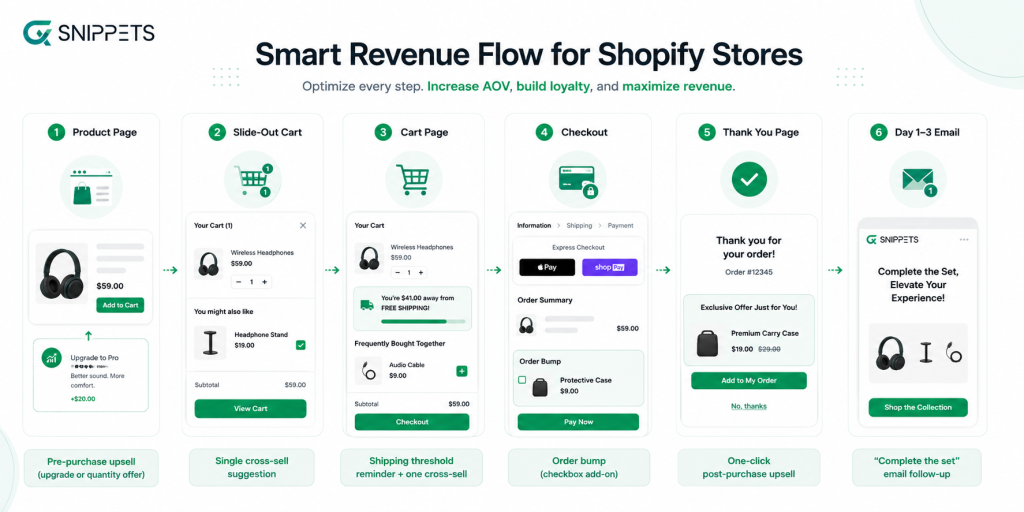
Each touchpoint targets a different psychological moment. The product page is about aspiration. The cart is about justification. Post-purchase is about momentum.
Brands running all six touchpoints with relevant, sequenced offers report 30–45% AOV lift versus running one or two tactics. The compounding effect is real.
The AOV vs. Conversion Rate Balance (Most Guides Ignore This)
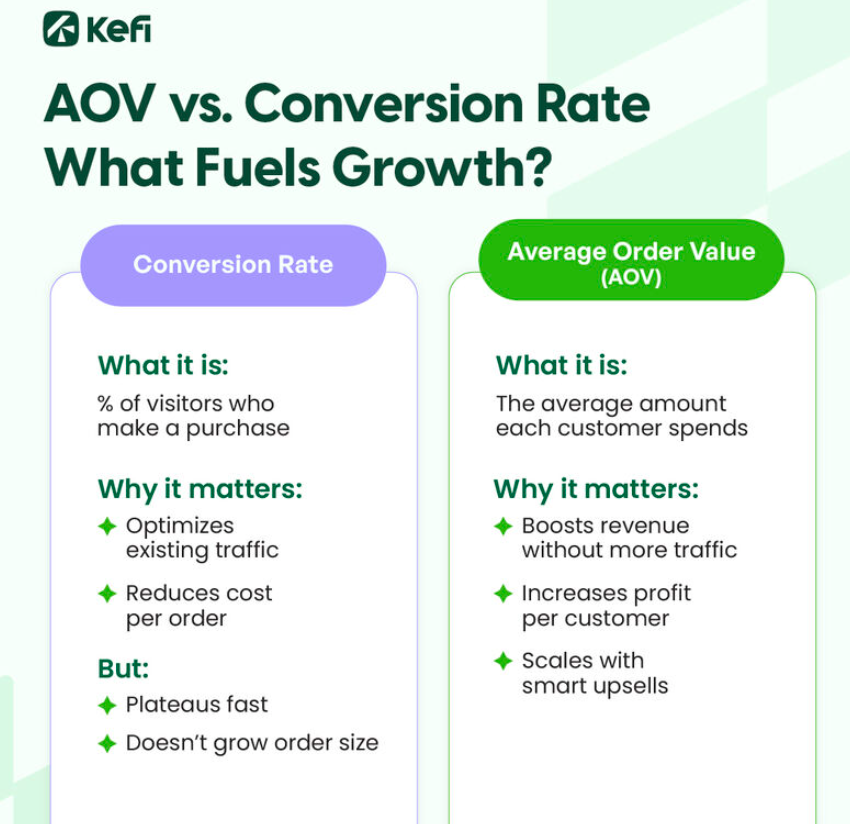
Here’s something you won’t read in most AOV guides: every tactic on this list creates friction. And friction, if you’re not careful, drops your conversion rate.
Source: Kefi Commerce
More AOV with fewer orders isn’t always a win. It depends entirely on your margins and traffic volume.
The way to manage this:
- Never show more than one upsell offer at the same placement point
- Every upsell must be dismissible in one tap on mobile — no dark patterns
- Post-purchase upsells should confirm the order first, then present the offer
- If conversion rate drops more than 3–5% after launching a new tactic, pull it and revise
The metric that captures both sides cleanly is net revenue per session — total revenue divided by total sessions. If that number is rising, your strategy is working. If it’s flat despite higher AOV, your conversion rate is taking a hit you need to address.
Common Mistakes That Quietly Kill Results
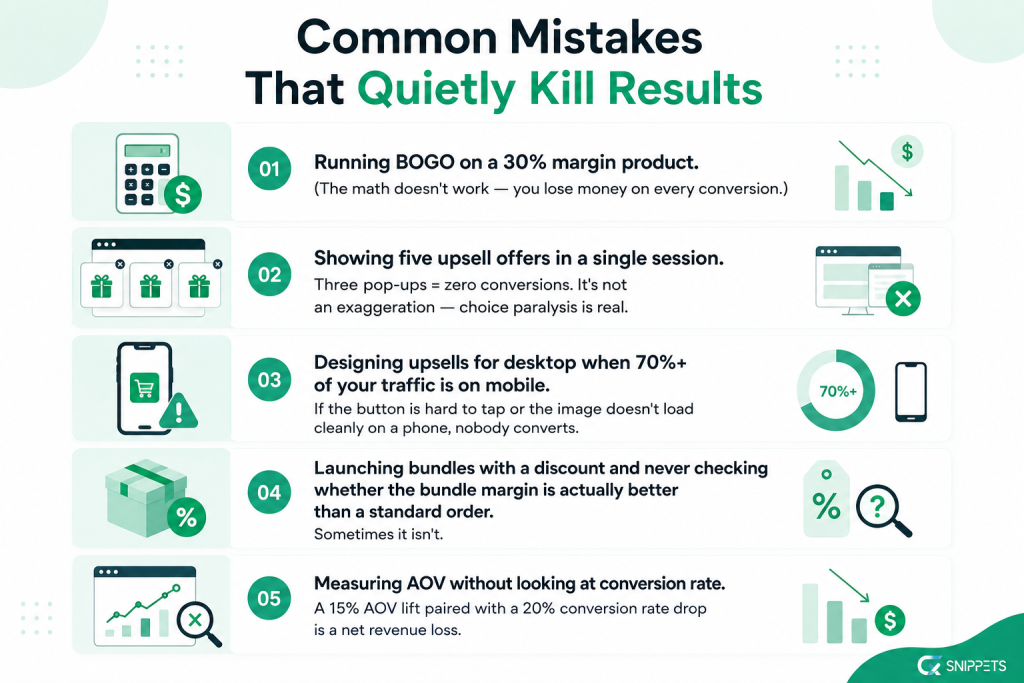
- Running BOGO on a 30% margin product. (The math doesn’t work — you lose money on every conversion.)
- Showing five upsell offers in a single session. Three pop-ups = zero conversions. It’s not an exaggeration — choice paralysis is real.
- Designing upsells for desktop when 70%+ of your traffic is on mobile. If the button is hard to tap or the image doesn’t load cleanly on a phone, nobody converts.
- Launching bundles with a discount and never checking whether the bundle margin is actually better than a standard order. Sometimes it isn’t.
- Measuring AOV without looking at conversion rate. A 15% AOV lift paired with a 20% conversion rate drop is a net revenue loss.
Your 48-Hour Launch Plan
Day 1 — Foundation
- Install your upsell and bundle app
- Pick your top 5 products by revenue — upsell offers go here first
- Build one fixed bundle per top product (main item + most logical accessory)
- Set free shipping threshold at 20% above current AOV
- Add shipping progress bar to cart drawer
Day 2 — Activation
- Enable a post-purchase upsell on thank you page for your top product
- Add a quantity break offer to your top consumable SKU
- Set up one cart cross-sell for your highest-margin complementary product
Measure for 14 days. Don’t change anything mid-test. Let the data settle before optimising.
Before You Launch, Take a Test Drive!
Final Word
The best-performing Shopify stores in 2026 aren’t necessarily the ones with the most traffic. They’re the ones that built a smarter path from first click to checkout and made every order count. You don’t need a massive catalogue or a complex tech stack to increase Shopify AOV like it means something. You need the right offer, in the right place, at the right moment in the customer journey.
Start with one lever. Get the margin math right. Build from there. The revenue compounds quietly, and that’s exactly what makes it worth doing.
About the Author: Muskaan Sabarwal

