

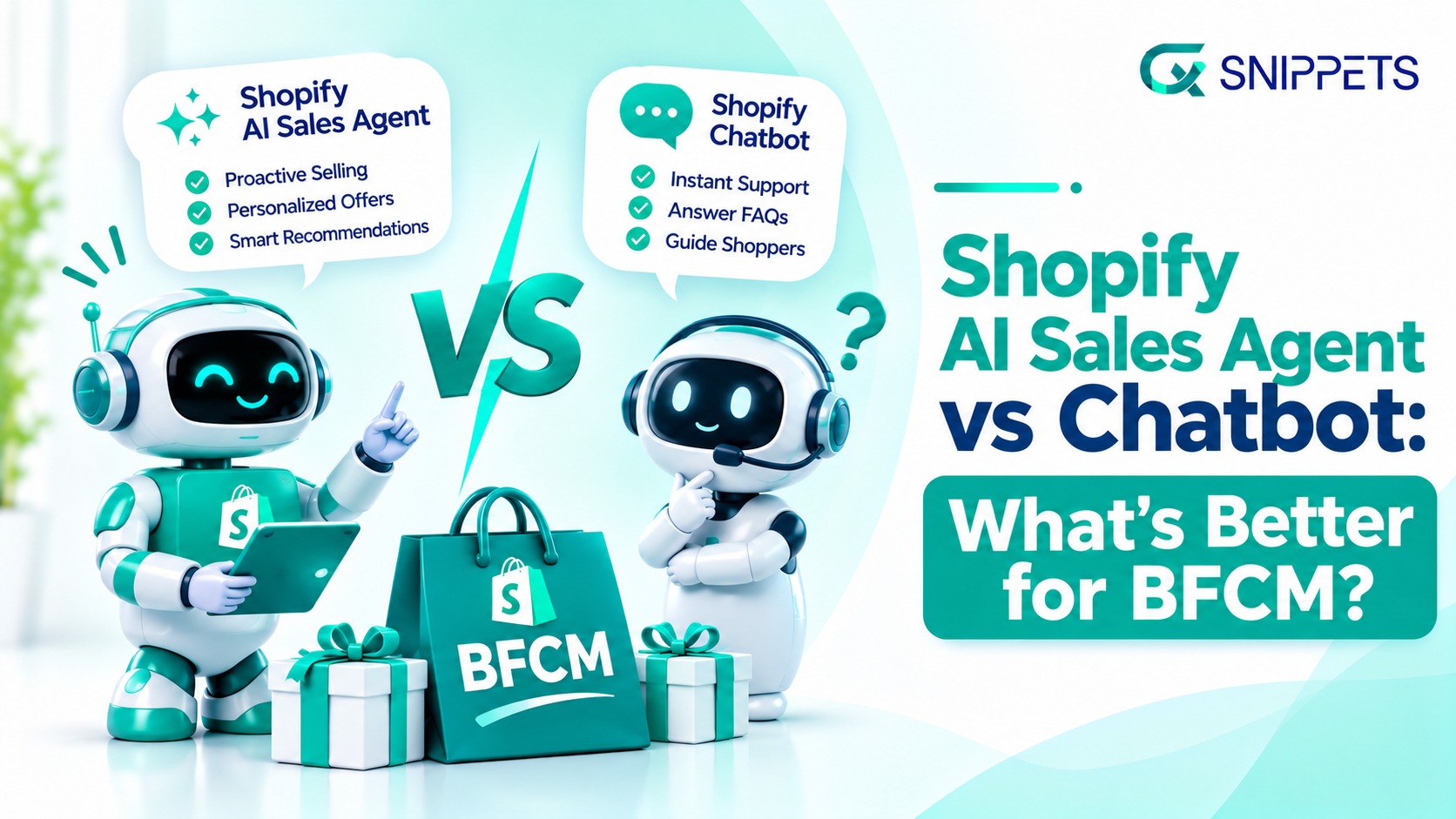
Black Friday is on November 27 and Cyber Monday follows on the 30th, so you’ve got a little over two weeks left.
By now you’re probably deep in the usual prep: ads scheduled, discount codes built, inventory counted twice.
Here’s the part that often gets left until the last minute. When BFCM traffic spikes, a flood of shoppers lands on your store at once, and plenty of them have questions.
Does this come in black? Which one makes a better gift? Will it arrive before Christmas? Even a great team can’t answer all of that one message at a time.
You’ve probably already got a chat widget on your store. The question is whether it will actually help you sell, or just answer “where’s my order?” on repeat.
In A Hurry? Here’s A Brief Summary…
Here’s the thing about Black Friday: shoppers rarely leave over price, they leave over doubt. A chatbot can tell them where their order is, but only something that can guide them will help them choose. In this blog, we break down how a basic chatbot and an AI sales agent really differ, where each one makes sense, and how to pick the right fit for your Shopify store. You’ll also find a quick checklist and a prep list, so you can get everything set up before November 27.
That’s the real difference between a basic chatbot and an AI sales agent, and it matters more than usual this time of year. Let’s work out which one fits your store.
In This Blog, We Will Talk About…
- First, What Do We Mean by “Chatbot” and “AI Sales Agent”?
- Why BFCM Exposes the Gap
- Where a Basic Chatbot Still Holds Up
- Where an AI Sales Agent Pulls Ahead During BFCM
- Where CXS AI Sales Agent Fits
- How to Decide: A Quick Checklist
- A Last-Minute BFCM Prep List
- Final Thoughts
(Jump to the section that interests you the most!)
First, what do we mean by “chatbot” and “AI sales agent”?
People use these two terms as if they were the same thing. They’re related, but they do different jobs, and that difference matters a lot once BFCM traffic arrives.
A chatbot is the classic chat widget. It usually runs on rules or a set list of FAQs. A shopper clicks the bubble, picks an option or types a question, and the bot matches it to a pre-written answer. It’s good at things you’ve already planned for, like shipping times, return policy, and order status.
Ask it something outside the script, and it can loop, stay vague, or hand the chat to a person.
An AI sales agent covers that same ground and then goes a step further. It can start a conversation when a shopper looks stuck or is about to leave. It works out what they’re actually after, suggests products from your catalog, and helps them add something to the cart without leaving the chat.
When a question needs a person, it passes the conversation to your team.
You decide the rules it follows, so it stays on-brand and doesn’t go off-script.
Think of the chatbot as a help desk and the agent as a shop assistant who also happens to know the help desk answers.
Here’s the quick side-by-side:
Comparison |
Basic Chatbot |
AI Sales Agent |
|---|---|---|
| Who Starts the Chat? | The shopper | Either one, it can reach out first |
| How It Answers | Scripted replies and FAQs | Understands the question and replies in context |
| Product Help | Links to product pages | Recommends products based on what the shopper says |
| Cart and Checkout | Sends shoppers to the store | Can add items to the cart inside the chat |
| When It’s Stuck | Dead end or a contact form | Hands off to your team with the chat history |
| Main Goal | Answer questions | Answer questions and help the sale along |
Neither is the right pick for every store. It depends on what your shoppers need from you, and BFCM changes that quite a bit.
Why BFCM exposes the gap
Bain & Company expects retail sales over the Black Friday to Cyber Monday weekend to top $85 billion this year. About 70% of US consumers say they plan to shop it, up from 64% last year. More people are heading to stores like yours, and a lot of them are in a hurry.
Think about how those shoppers behave. They arrive with a deal in mind, open five tabs and compare. If they can’t find what they need in a minute or two, they move on. Nobody emails you and waits until tomorrow.
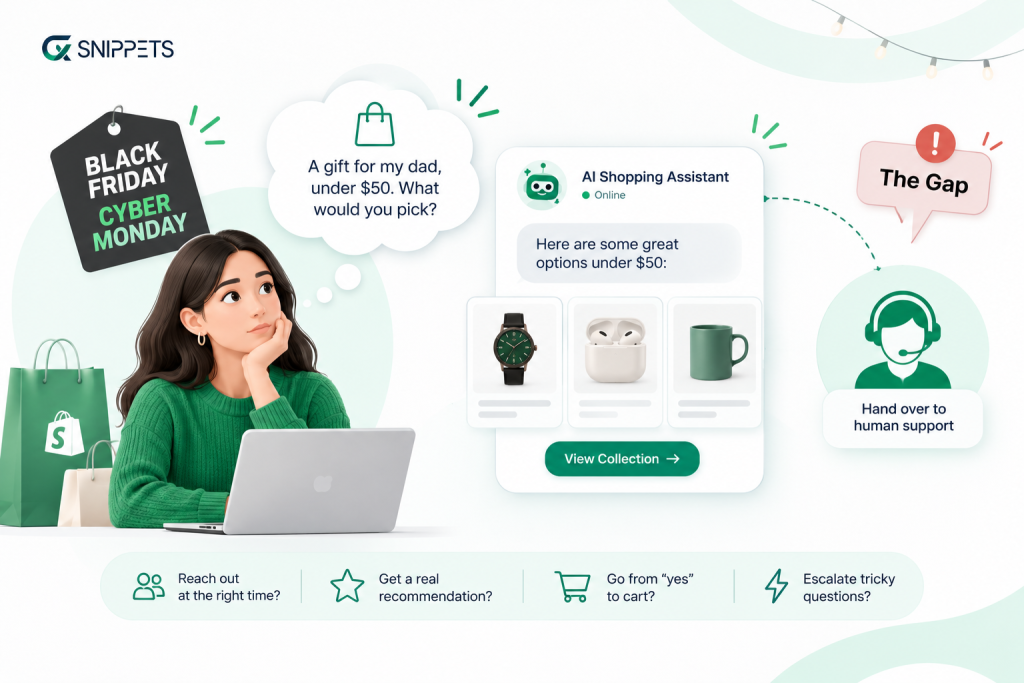
That’s where a basic question-and-answer widget starts to feel thin. Plenty of BFCM questions have nothing to do with policy. They sound like, “I need a gift for my dad, under $50. What would you pick?” A scripted flow can point to a collection page, but it can’t really help someone decide. And the shoppers who most need that nudge are often the ones who never open the chat. They just quietly leave.
Then there’s your team. Even with extra hands that weekend, the queue fills up fast. Every message that needs a person is a message waiting, and during a sale, waiting costs you orders.
So the gap isn’t really about technology. It’s about what happens in the few minutes when a shopper is interested but not yet sure:
- Does anyone reach out to them?
- Can they get a real recommendation, not just a link?
- Can they get from “yes, that one” to the cart without starting over?
- If the question is too tricky, does a human pick it up without making them repeat themselves?
Keep those four questions in mind, because we’ll come back to them.
Where a basic chatbot still holds up
Let’s be fair here, because a basic chatbot isn’t a bad choice. For some stores it’s exactly what’s needed.
If most of your messages are about order tracking, return policy or shipping times, a scripted bot handles them well. The answers don’t change, so there’s nothing to get wrong. Shoppers get a quick reply, and your inbox stays calmer.
It also suits stores with a small catalog. When you sell five products with clear differences, people rarely need help choosing. A product page and a good FAQ do most of the work.
Then there’s the practical side. A chatbot is usually quick to set up and cheap to run. If BFCM is two weeks away and you want something live this weekend without a lot of thinking, that counts for a lot.
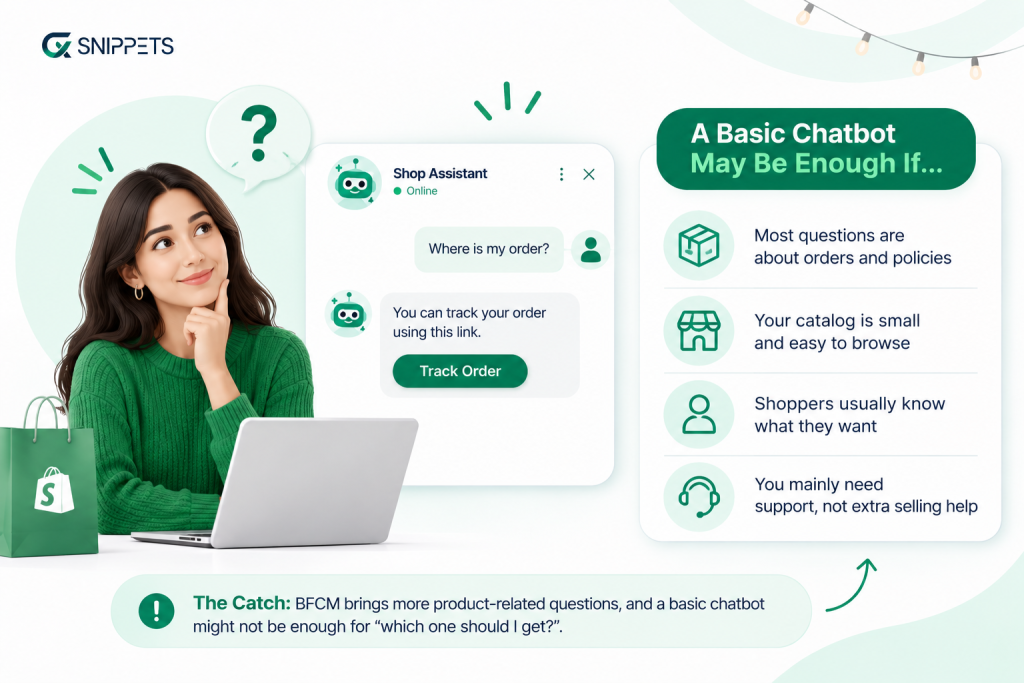
A few signs a basic chatbot may be enough for you:
- Most questions you get are about orders and policies, not products.
- Your catalog is small and easy to browse.
- Your shoppers mostly know what they want before they arrive.
- You mainly need support covered, not extra selling help.
The catch is that BFCM tends to bring a different kind of question. When shoppers start asking “which one should I get?”, a chatbot built for FAQs runs out of road. That’s the point where the next option starts to make sense.
Where an AI sales agent pulls ahead during BFCM
Remember the four questions from earlier? This is where an AI sales agent starts to answer them.
- It gives real recommendations. This is the big one for BFCM. When a shopper says, “I need a gift for my dad, under $50,” the agent can work out what they mean and suggest products from your catalog that fit. It’s closer to how a good shop assistant talks than a menu of options, and it helps shoppers who don’t know what they want yet.
- It gets them to the cart without friction. A recommendation is only useful if the next step is easy. With in-chat cart additions, a shopper can say yes to a product and add it without leaving the conversation or hunting through the store again. Every extra click on Black Friday is a chance for someone to wander off.
- It keeps up with your promos. BFCM offers change fast: a Friday morning deal, a weekend bundle, a Cyber Monday extension. An agent that can handle discount and promo questions means shoppers get the right answer without waiting for someone on your team to reply.
- It hands off to a person when it should. No AI covers everything. Some questions are tricky, and some shoppers simply want a human. A good setup passes the chat to your team with the full conversation, so the shopper doesn’t have to repeat themselves. Your team spends its time on the conversations that need them, not the routine ones.
- You stay in control. Before launch, you can set the rules it follows, covering what it can say, how it sounds and what it shouldn’t promise. That matters during a sale, when one wrong claim about stock or shipping can turn into a pile of support tickets.
None of this makes a chatbot useless. It means that when shoppers need guidance, not just answers, an agent covers more of the journey.
Where CXS AI Sales Agent fits
This is the gap we built CXS AI Sales Agent to close. It’s a Shopify app that works as a sales rep on your store, so your customers get help the moment they need it, even when your team is busy or offline.
Here’s what it does for you:
- Recommends products from your catalog based on what a customer describes.
- Lets customers add items to the cart right inside the chat.
- Passes the chat to your team through a shared live inbox when a person is needed, with the full conversation attached.
- Lets you set the rules, so you control how it talks and what it says.
Setup needs no code, so you can have it running well before the sale starts.
On pricing, there’s a free plan with 70 AI conversations a month, which is a good way to try it.
Paid plans start at $12 a month. The $29 Grow plan is the best fit for BFCM, since it adds unlimited proactive chat, discount and promo automation, and live handoff to your team, with room for 5,000 conversations a month.
Every paid plan comes with a 7-day free trial, so you can test it before Black Friday on the 27th.
Try CXS AI Sales Agent on Your Store
How to decide: a quick checklist
Still not sure which way to go? Run through these questions with your own store in mind. Be honest, and go with your gut.
- How big is your catalog? If you sell a handful of products, shoppers can usually find their way. If you have hundreds, they’ll need help choosing.
- How often do shoppers ask “which one should I pick?” Check your inbox and past chats. Product questions point toward an agent, and order and policy questions point toward a chatbot.
- How many people will be on your team that weekend? If it’s just you, or a very small crew, every chat you don’t have to answer by hand gives you time back.
- Are you running layered promos? A Friday deal, a weekend bundle, and a Cyber Monday extension create a lot of “does this code work with that?” questions. Something that can handle them quickly will help.
- How much traffic are you expecting? Think about how many chats you’ll realistically get, since conversation limits vary by plan.
The simple rule: If most of your chats are support questions, a chatbot is enough. If most are buying questions, an AI sales agent will serve you better.
A last-minute BFCM prep list
Black Friday is just over two weeks away, so here’s what to get done, whichever route you choose:
- Set it up and test it this week. Chat with it yourself like a shopper would. Ask about products, shipping, and a discount, and fix anything that sounds off.
- Write down your promo rules. List your BFCM offers, dates and any exclusions, so the chat gives the right answer when a deal changes mid-weekend.
- Set your guardrails. Decide what it can say about stock, delivery dates and refunds, and what it should leave to your team.
- Brief whoever covers handoffs. Make sure someone is watching the inbox on Black Friday and Cyber Monday, and that they know when to step in.
- Check your conversation limit. Compare your plan’s monthly limit against the traffic you expect, and upgrade before the rush, not during it.
If you’re trying the free trial, start it now so you have a few days of real chats to learn from before the 27th.
Final thoughts
You don’t need a fancy setup to have a good BFCM. You need shoppers to get help at the moment they need it. If your customers mostly ask about orders and policies, a basic chatbot will serve you well. If they ask what to buy, an AI sales agent can cover more of the journey and give your team some breathing room.
If you’d like to try it, you can install CXS AI Sales Agent from the Shopify App Store. Start on the free plan, or test a paid plan free for 7 days. There’s still time to get it set up before Black Friday.
Good luck out there. We hope it’s your best BFCM yet.
About the Author: Mohd Talib

